


Page 33 - AIH-1-1
P. 33
Artificial Intelligence in Health                                                        NLP in EHR


            4.3. Discourse level

            Suppose a patient is experiencing symptoms such as a cold
            and headache; in this scenario, the system should diagnose
            this condition as the flu.
            4.4. Pragmatic level
            Consider a scenario where a patient is experiencing acid
            reflux, which is possibly attributed to previous medications.
            In this scenario, the system should conduct a search for the
            patient’s previous medication, identify recent medicines,
            and assess whether the current symptoms result from the
            side effects of any previous medicines or represent a totally
            new situation. This NLP level is required to enhance the
            decision support capabilities of the system.
            5. Limitations and future scope

            This study has several limitations:
            (i)  The literature review relied on articles collected from
               the PubMed database. Potential omission of significant
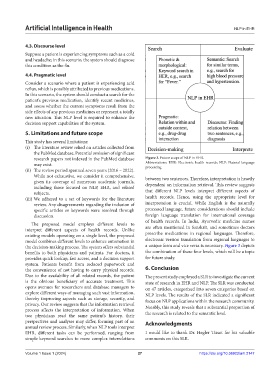
               research papers not indexed in the PubMed database   Figure 3. Future scope of NLP in EHR.
               may exist.                                      Abbreviations: EHR: Electronic health records; NLP: Natural language
            (ii)  The review period spanned seven years (2016 – 2022).   processing.
               While not exhaustive, we consider it comprehensive,   between two sentences. Therefore, interpretation is heavily
               given its coverage of numerous academic journals,
               including those focused on NLP, EHR, and related   dependent on information retrieval. This review suggests
               subjects.                                       that different NLP levels interpret different aspects of
            (iii) We adhered to a set of keywords for the literature   health records. Hence, using the appropriate level for
               review. Any disagreements regarding the inclusion of   interpretation is crucial. While English is the naturally
               specific  articles  or keywords were  resolved  through   processed language, future considerations should include
               discussion.                                     foreign language translation for international coverage
                                                               of health records. In India, Ayurvedic medicine names
              The  proposed  model  employs  different levels  to
            interpret different aspects of health records. Unlike   are often mentioned in Sanskrit, and sometimes doctors
            existing models operating on a single level, the proposed   prescribe medications in regional languages. Therefore,
            model combines different levels to enhance automation in   electronic version translation from regional languages to
            the decision-making process. The system offers substantial   a unique form and vice versa is necessary. Figure 3 depicts
            benefits to both physicians and patients. For doctors, it   the combination of these four levels, which will be a topic
            provides quick lookup, fast access, and a decision support   for future study.
            system. Patients benefit from reduced paperwork and
            the convenience of not having to carry physical records.   6. Conclusion
            Due to the availability of all related records, the patient   The present study employed a SLR to investigate the current
            is  the  obvious  beneficiary  of  accurate  treatment.  This   state of research in EHR and NLP. The SLR was conducted
            opens avenues for researchers and database managers to   on 47 articles, categorized into seven categories based on
            explore different ways of managing such vast information,   NLP levels. The results of the SLR indicated a significant
            thereby improving aspects such as storage, security, and   focus on NLP applications within the research community.
            privacy. Our review suggests that the information retrieval   Notably, this study reveals that a substantial proportion of
            process affects the interpretation of information. When
            two  physicians  read  the  same  patient’s  history,  their   the research is related to the semantic level.
            perspectives and analyses may differ, forming part of an   Acknowledgments
            annual review process. Similarly, when NLP tools interpret
            EHR,  different  tasks  can  be  performed,  ranging  from   I would like to thank Dr.  Hegler Tissot for his valuable
            simple keyword searches to more complex interrelations   comments on this SLR.


            Volume 1 Issue 1 (2024)                         27                        https://doi.org/10.36922/aih.2147

