


Page 51 - AIH-1-1
P. 51
Artificial Intelligence in Health                                AI model for cardiovascular disease prediction


            the synthetic minority oversampling technique (SMOTE)   3. Materials and methods
            to enrich the data. Regarding model performance in terms
            of discrimination, GBT and RF were the models with the   3.1. Implementation of ANN-GA for CVDs model
            highest receiver operating characteristic curve of 97.8%   In this research, a CVD prediction model was developed
            and 97.7%, respectively. The discriminative powers of ET,   using a combination of techniques based on the evolution
            LR, and DNN were 96.8%, 96.4%, and 95.3%, respectively,   theory – GA and ANN. This ANN-GA model was used
            with the latter exhibiting the least discriminative power. In   for the correlated attribute selection, training, and
            terms of reliability, LR predictions were the least calibrated   optimization of the CVD selected features to achieve
            compared  with  the  other  four  algorithms.  Thus,  despite   better prediction accuracy. The ANN utilized a multilayer
            increasing the training time, SMOTE was proven to further   perceptron to receive the transmitted signal, process the
            improve the model performance of LR, while algorithms
            like GBT and DNN performed well with class-imbalanced   signal (neurons), and compute the output of each neuron
            data .                                             for weighted using back-propagation to adjust the NN
               [43]
                                                               model  parameters  for  a  reduced  mean  squared  error
              Khan  et al. utilized a machine learning algorithm   (MSE). While the GA is an optimization searching agent
            for  the  accurate prediction and  decision-making for   in the evolution theory, that is used to optimize the output
            CVD  patient .  Simple random  sampling  was  used  to   performance of a classifier model using a supervised
                       [44]
            select heart disease patients from the Khyber Teaching   machine learning algorithm (SMLA). The function of GA
            Hospital and Lady Reading Hospital, Pakistan. Some of   evolution initiates the process from a randomly generated
            the machine learning methods involved are DT, RF, and   population for an individual which changes at every
            LR. The performance of the proposed machine learning   iteration in the loops to formulate an offspring called
            algorithm was estimated using numerous conditions to       [45]
            recognize the most suitable machine learning algorithm   generation  The fitness (best chromosome) of every
            in the class of models. The RF algorithm has the highest   individual generated within the population was appraised,
            accuracy of prediction, sensitivity, and recursive operative   and the fittest was chosen (selection of chromosome) by
            characteristic curve of 85.01%, 92.11%, and 87.73%,   computing the probability for being selected from among
            respectively, for CVD prediction. It also has the least   the best chromosome in the population in proportion
            specificity and  misclassification errors  of 43.48% and   to the sum of the fitness among individuals as given
                                                                           [46]
            8.70%, respectively. The overall performance evaluation   in Equation I . Nevertheless, the generation of the
            result showed that the RF algorithm is the most appropriate   individual population can be modified by crossover and
            algorithm  for  CVD  classification  and  prediction .   mutation to form a newly evolved generation candidate
                                                        [44]
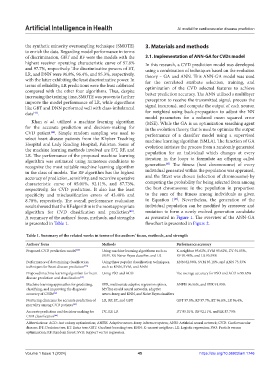
            A summary of the authors’ focus, methods, and strengths   as presented in Figure 1. The overview of the ANN-GA
            is presented in Table 1.                           flowchart is presented in Figure 2.

            Table 1. Summary of the related works in terms of the authors’ focus, methods, and strength
            Authors’ focus                  Methods                         Performance accuracy
            Proposed CVD prediction model [35]  Using machine learning algorithms such as   K-neighbor 95.62%, SVM 95.62%, DT 91.05%,
                                            SVM, RF, Naive Bayes classifier, and LR  RF 95.40%, and LR 95.59%
            Performance of data mining classification   Using three popular classification techniques,   KNN 82.96%, SVM 85.18%, and ANN 73.33%
            techniques for heart disease prediction [36]  such as KNN, SVM, and ANN
            Proposed machine learning algorithm for heart   Using PSO and ACO  The average accuracy for PSO and ACO is 99.65%
            disease prediction and classification [38]
            Machine learning approaches for predicting,   SVR, multivariate adaptive regression splines,   ANFIS 96.56%, and SVR 91.95%
            classifying, and improving the diagnosis   M5Tree model neural networks, adaptive
            accuracy of CVDs [42]           neuro-fuzzy, and KNN, and Naive Bayes classifiers
            Nurturing clinicians for accurate prediction of   LR, RF, ET, and GBT  GBT 97.8%, RF 97.7%, ET 96.8%, LR 96.4%,
            mortality among CVD patients [43]
            Accurate prediction and decision-making for   DT, RF, LR        DT 85.01%, RF 92.11%, and LR 87.73%
            CVD classification [44]
            Abbreviations: ACO: Ant colony optimization; ANFIS: Adaptive neuro-fuzzy inference system; ANN: Artificial neural network; CVD: Cardiovascular
            disease; DT: Decision tree; ET: Extra tree; GBT: Gradient boosting tree; KNN: K-nearest neighbor; LR: Logistic regression; PSO: Particle swarm
            optimization; RF: Random forest; SVR: Support vector regression.


            Volume 1 Issue 1 (2024)                         45                        https://doi.org/10.36922/aih.1746

