


Page 54 - AIH-1-1
P. 54
Artificial Intelligence in Health                                AI model for cardiovascular disease prediction


            and two output layers. The effect of the number of hidden
            neurons on the network performance was carried out, and
            five different numbers of hidden neurons (10, 20, 25, and
            30) were investigated. In each case, the network was trained
            several times and the best performance was recorded
            using the Levenberg algorithm. The number of training
            cycles required for proper generalization of outputs
            was determined through the trial-and-error method.
            Furthermore, the threshold function was determined
            through  trial  and  error  (0.5).  The  NN  was  trained  and
            tested using 76 samples, of which 70% samples for training
            and 30% samples were for testing 14, 10, and 8 attributes,
            and the number of datasets varied between 2000, 1500,
            1000, and 500, respectively. The data collected for training
            was inputted into the training network designed. The
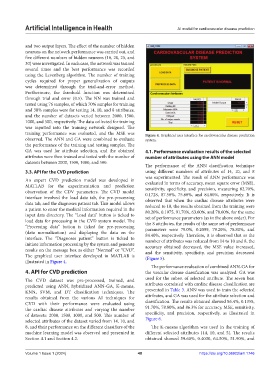
            training performance was evaluated, and the MSE was   Figure 4. Graphical user interface for cardiovascular disease prediction
            observed. The ANN and GA were combined to evaluate   system.
            the performance of the training and testing samples. The
            GA was used for attribute selection, and the obtained   4.1. Performance evaluation results of the selected
            attributes were then trained and tested with the number of   number of attributes using the ANN model
            datasets between 2000, 1500, 1000, and 500.
                                                               The performance of the ANN classification technique
            3.3. API for the CVD prediction                    using different numbers of attributes of 14, 10, and 8
                                                               was experimented. The result of ANN performance was
            An  expert  CVD  prediction  model  was  developed  in   evaluated in terms of accuracy, mean square error (MSE),
            MATLAB  for  the  experimentation  and  prediction
            observation of the CDV parameters. The CVD model   sensitivity, specificity, and precision, measuring 82.70%,
                                                               0.1728, 87.50%, 75.80%, and 84.00%, respectively. It is
            interface involved the load data tab, the pre-processing   observed that when the cardiac disease attributes were
            data tab, and the diagnoses patient tab. This model allows   reduced to 10, the results obtained from the training were
            a patient to enter the medical information required in the   80.20%, 0.1975, 91.70%, 63.60%, and 78.60%, for the same
            input data directory. The “Load data” button is ticked to   set of performance parameters (as in the above order). For
            load data for processing in the CVD system model. The   the 8 attributes, the results of the same set of performance
            “Processing data” button is ticked for pre-processing   parameters were 79.0%, 0.2099, 79.20%, 78.80%, and
            (data normalization) and displaying the data on the   84.40%, respectively. Therefore, it is observed that as the
            interface. The “Diagnoses patient” button is ticked to   number of attributes was reduced from 14 to 10 and 8, the
            initiate information processing by the system and generate   accuracy obtained decreased, the MSE value increased,
            results on the message box as either “Normal” or “CVD”.   and the sensitivity, specificity, and precision decreased
            The  graphical user interface developed in MATLAB is   (Figure 5).
            illustrated in Figure 4.
                                                                 The performance evaluation of combined ANN-GA for
            4. API for CVD prediction                          the vascular disease classification was analyzed. GA was

            The CVD dataset was pre-processed, trained, and    used for the subset of selected attribute. The seven best
            predicted using ANN, hybridized ANN-GA, K-means,   attributes correlated with cardiac disease classification are
            KNN, SVM, and DT  classification  techniques.  The   presented in Table 3. ANN was used to train the selected
            results obtained from the various AI techniques for   attributes, and GA was used for the attribute selection and
            CVD with their performance were evaluated using    classification. The results obtained showed 86.4%, 0.1358,
            the cardiac disease attributes and varying the number   91.70%, 78.80%, and 86.3% for accuracy, MSE, sensitivity,
            of datasets: 2000, 1500, 1000, and 500. This number of   specificity, and precision, respectively, as illustrated in
            selected attributes of the dataset varied from 14, 10, and   Figure 6.
            8, and their performance on the different classifiers of the   The K-means algorithm was used in the training of
            machine learning model was observed and presented in   different selected attributes (14, 10, and 5). The results
            Section 4.1 and Section 4.2.                       obtained showed 59.60%, 0.4030, 64.50%, 51.90%, and


            Volume 1 Issue 1 (2024)                         48                        https://doi.org/10.36922/aih.1746

