


Page 10 - AIH-2-1
P. 10
Artificial Intelligence in Health                                           AI in higher medical education


                         A                                  B


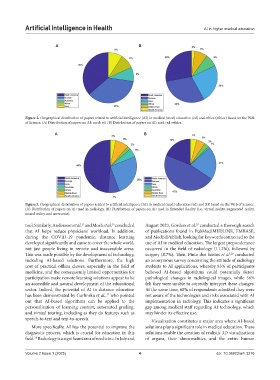
            Figure 2. Geographical distribution of papers related to artificial intelligence (AI) in medical (med) education (ed) and ethics (ethics) based on the Web
            of Science. (A) Distribution of papers on AI+med+ed. (B) Distribution of papers on AI+med+ed+ethics.

                        A                                     B


            Figure 3. Geographical distribution of papers related to artificial intelligence (AI) in medical (med) education (ed) and XR based on the Web of Science.
            (A) Distribution of papers on AI+med in radiology. (B) Distribution of papers on AI+med in Extended Reality (i.e., virtual reality, augmented reality,
            mixed reality, and metaverse).

            tool. Similarly, Andersson et al.  and Mosh et al.  concluded   August 2023, Gordon et al.  conducted a thorough search
                                    15
                                                                                    19
                                                 16
            that AI helps reduce physicians’ workload. In addition,   of publications found in PubMed/MEDLINE, EMBASE,
            during the COVID-19 pandemic, distance learning    and MedEdPublish, looking for keywords connected to the
            developed significantly and came to cover the whole world,   use of AI in medical education. The largest preponderance
            not just people living in remote and inaccessible areas.   occurred in the field of radiology (11.2%), followed by
            This was made possible by the development of technology,   surgery (8.7%). Then, Pinto dos Santos et al.  conducted
                                                                                                   20
            including AI-based solutions. Furthermore, the high   an anonymous survey concerning the attitude of radiology
            cost of practical offline classes, especially in the field of   students to AI applications, whereby 83% of participants
            medicine, and the consequently limited opportunities for   believed AI-based algorithms could potentially detect
            participation make remote learning solutions appear to be   pathological changes in radiological images, while 56%
            an accessible and natural development of the educational   felt they were unable to correctly interpret these changes.
            sector. Indeed, the potential of AI in distance education   At the same time, 68% of respondents admitted they were
            has been demonstrated by Garlinska et al.,  who pointed   not aware of the technologies and risks associated with AI
                                              17
            out that AI-based algorithms can be applied to the   implementation in radiology. This indicates a significant
            personalization of learning content, automated grading,   gap among medical staff regarding AI technology, which
            and virtual touring, including as they do features such as   may hinder its effective use.
            speech-to-text and text-to-speech.                   Visualization constitutes a major area where AI-based
              More specifically, AI has the potential to improve the   solutions play a significant role in medical education. These
            diagnostic process, which is crucial for education in this   solutions enable the creation of realistic 3D visualizations
            field.  Radiology is a significant area of medicine. In July and   of organs, their abnormalities, and the entire human
                18

            Volume 2 Issue 1 (2025)                         4                                doi: 10.36922/aih.3276

