


Page 9 - AIH-2-1
P. 9
Artificial Intelligence in Health                                           AI in higher medical education


                        A                                      B


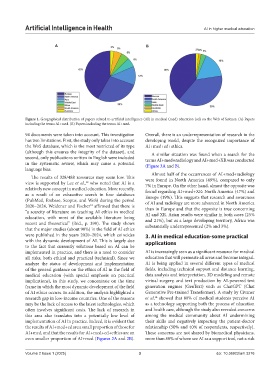
            Figure 1. Geographical distribution of papers related to artificial intelligence (AI) in medical (med) education (ed) on the Web of Science. (A) Papers
            including the terms AI+med. (B) Papers including the terms AI+med.

            94 documents were taken into account. This investigation   Overall, there is an underrepresentation of research in the
            has two limitations. First, the study only takes into account   developing  world,  despite the recognized  importance  of
            the WoS database, which is the most restricted of its type   AI+med+ed+ethics.
            (although this  ensures  the  integrity  of the  dataset),  and   A similar situation was found when a search for the
            second, only publications written in English were included   terms AI+med+radiology and AI+med+XR was conducted
            in  the systematic  review,  which  may cause a  potential   (Figure 3A and B).
            language bias.
                                                                 Almost half of the occurrences of AI+med+radiology
              The results of 328/488 resources may seem low. This
            view is supported by Lee et al.,  who noted that AI is a   were found in North America (49%), compared to only
                                      12
                                                               7% in Europe. On the other hand, almost the opposite was
            relatively new concept in medical education. More recently,   found regarding AI+med+XR: North America (47%) and
            as a result of an exhaustive search in four databases   Europe (19%). This suggests that research and awareness
            (PubMed, Embase, Scopus, and WoS) during the period   of AI and radiology are more advanced in North America
            2020–2024, Weidener and Fischer  affirmed that there is   than in Europe and that the opposite is true concerning
                                       13
            “a scarcity of literature on teaching AI ethics in medical   AI and XR. Asian results were similar in both cases (25%
            education,  with  most  of  the  available  literature  being   and 21%), but as a large developing territory, Africa was
            recent and theoretical” (ibid., p.  399). The study shows   substantially underrepresented (2% and 3%).
            that the major studies (about 90%) in the field of AI ethics
            were published in the years 2020–2024, which coincides   3. AI in medical education-some practical
            with the dynamic development of AI. This is largely due   applications
            to the fact that currently solutions based on AI can be
            implemented in practice, and there is a need to consider   AI is increasingly seen as a significant resource for medical
            all risks, both ethical and practical (technical). Since we   education that will permeate all areas and become integral.
            analyze the status of development and implementation   AI is being applied in several different types of medical
            of the general guidance on the ethics of AI in the field of   fields, including technical support and distance learning,
            medical education (with special emphasis on practical   data analysis and interpretation, 3D modeling and remote
            implications), in this study, we concentrate on the time   virtual surgery, and text production by AI-powered text
            frame in which the most dynamic development of the field   generation engines (GenText) such as ChatGPT (Chat
            of AI ethics occurs. In addition, the analysis highlighted a   Generative Pre-trained Transformer). A study by Civaner
                                                                   14
            research gap in low-income countries. One of the reasons   et al.  showed that 80% of medical students perceive AI
            may be the lack of access to the latest technologies, which   as a technology supporting both the process of education
            often involves significant costs. The lack of research in   and health care, although the study also revealed concerns
            this  area  also  translates  into  a  potentially  low  level  of   among the medical community about AI undermining
            implementation of AI in practice. Indeed, it is evident that   their skills and negatively impacting the patient-doctor
            the results of AI+med+ed are a small proportion of those for   relationship (50% and 40% of respondents, respectively).
            AI+med, and that the results for AI+med+ed+ethics are an   These concerns are not shared by biomedical physicians,
            even smaller proportion of AI+med (Figures 2A and 2B).   more than 80% of whom see AI as a support tool, not a risk


            Volume 2 Issue 1 (2025)                         3                                doi: 10.36922/aih.3276

