


Page 124 - AJWEP-22-4
P. 124
Shah, et al.

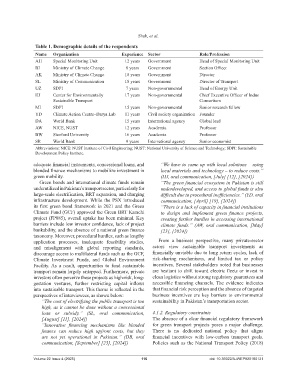
                 Table 1. Demographic details of the respondents
                 Name   Organization                   Experience  Sector                Role/Profession
                 AH     Special Monitoring Unit         12 years  Government             Head of Special Monitoring Unit
                 BI     Ministry of Climate Change      8 years   Government             Section Officer
                 AK     Ministry of Climate Change      18 years  Government             Director
                 SL     Ministry of Communication       18 years  Government             Director of Transport
                 UZ     SDPI                            7 years   Non-governmental       Head of Energy Unit
                 HJ     Center for Environmentally      17 years  Non-governmental       Chief Executive Officer of Indus
                        Sustainable Transport                                            Consortium
                 MI     SDPI                            15 years  Non-governmental       Senior research fellow
                 YD     Climate Action Centre–Darya Lab  11 years  Civil society organization  Founder
                 DA     World Bank                      15 years  International agency   Global lead
                 AW     NICE, NUST                      12 years  Academia               Professor
                 BW     Stanford University             16 years  Academia               Professor
                 SR     World Bank                      9 years   International agency   Senior economist
                 Abbreviations: NICE: NUST Institute of Civil Engineering; NUST: National University of Science and Technology; SDPI: Sustainable
                 Development Policy Institute.

                adequate financial instruments, concessional loans, and      “We have to come up with local solutions – using
                blended finance mechanisms to mobilize investment in    local materials and technology – to reduce costs.”
                green mobility.                                         (HJ, oral communication, [July] [12], [2024])
                  Green bonds and international climate funds remain      “The green financial ecosystem in Pakistan is still
                underutilized in Pakistan’s transport sector, particularly for   underdeveloped, and access to global funds is also
                large-scale electrification, BRT expansion, and charging   difficult due to procedural inefficiencies.” (YD, oral
                infrastructure development. While the PSX introduced    communication, [April] [19], [2024])
                its first green bond framework in 2021 and the Green      “There is a lack of capacity in financial institutions
                Climate Fund (GCF) approved the Green BRT Karachi       to  design  and  implement  green  finance  projects,
                project (FP085), overall uptake has been minimal. Key   creating further hurdles in accessing international
                barriers include low investor confidence, lack of project   climate  funds.”  (AW,  oral  communication,  [May]
                bankability, and the absence of a national green finance   [23], [2024])
                taxonomy. Moreover, procedural hurdles, such as lengthy
                application  processes,  inadequate  feasibility  studies,   From a business  perspective, many private-sector
                and  misalignment  with  global  reporting  standards,   actors  view  sustainable  transport  investments  as
                discourage access to multilateral funds such as the GCF,   financially unviable due to long return cycles, lack of
                Climate  Investment  Funds,  and  Global  Environment   risk-sharing  mechanisms,  and  limited  tax  or policy
                Facility. As a result, opportunities to fund sustainable   incentives. Several stakeholders noted that businesses
                transport remain largely untapped. Furthermore, private   are hesitant to shift toward electric fleets or invest in
                investors often perceive these projects as high-risk, long-  clean logistics without strong regulatory guarantees and
                gestation  ventures,  further  restricting  capital  inflows   accessible financing  channels. The  evidence indicates
                into sustainable transport. This theme is reflected in the   that financial risk perception and the absence of targeted
                perspectives of interviewees, as shown below:       business incentives  are key barriers to environmental
                   “The cost of electrifying the public transport is too   sustainability in Pakistan’s transportation sector.
                   high, as it cannot be done without a concessional
                   loan or subsidy.” (SL, oral communication,       4.1.2. Regulatory constraints
                   [August] [11], [2024])                           The absence of a clear financial regulatory framework
                   “Innovative  financing  mechanisms  like  blended   for green transport projects poses a major challenge.
                   finance  can  reduce  high  upfront  costs,  but  they   There is no dedicated  national  policy that aligns
                   are  not  yet  operational  in  Pakistan.”  (DB,  oral   financial  incentives  with  low-carbon  transport  goals.
                   communication, [September] [23], [2024])         Policies such as the National Transport Policy (2018)


                Volume 22 Issue 4 (2025)                       116                           doi: 10.36922/AJWEP025160121

