


Page 132 - AJWEP-22-4
P. 132
Wang, et al.

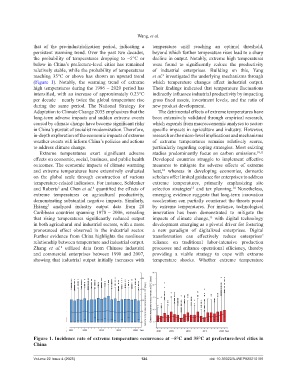
                that  of  the  pre-industrialization  period,  indicating  a   temperature  until  reaching an optimal  threshold,
                persistent warming trend. Over the past two decades,   beyond which further temperature rises lead to a sharp
                the  probability  of  temperatures  dropping  to  −5°C  or   decline in output. Notably, extreme high temperatures
                below in China’s prefecture-level cities has remained   were  found  to  significantly  reduce  the  productivity
                relatively stable, while the probability of temperatures   of  industrial  enterprises.  Building  on  this,  Yang
                reaching 35°C or above has shown  an upward trend   et al.  investigated the underlying mechanisms through
                                                                         9
                (Figure  1). Notably, the warming trend of extreme   which  temperature  changes  affect  industrial  output.
                high temperatures during the 1986 – 2020 period has   Their  findings  indicated  that  temperature  fluctuations
                intensified, with an increase of approximately 0.23°C   indirectly influence industrial productivity by impacting
                per decade – nearly twice the global temperature rise   gross fixed assets, investment levels, and the ratio of
                during  the  same  period.  The  National  Strategy  for   new product development.
                Adaptation to Climate Change 2035 emphasizes that the   The detrimental effects of extreme temperatures have
                long-term adverse impacts and sudden extreme events   been extensively validated through empirical research,
                caused by climate change have become significant risks   which expands from macroeconomic analyses to sector-
                in China’s pursuit of socialist modernization. Therefore,   specific impacts in agriculture and industry. However,
                in-depth exploration of the economic impacts of extreme   research on the micro-level implications and mechanisms
                weather events will inform China’s policies and actions   of extreme  temperatures  remains  relatively  scarce,
                to address climate change.                          particularly regarding coping strategies. Most existing
                  Extreme  temperatures  exert  significant  adverse   studies predominantly  focus on carbon emissions. 10,11
                effects on economic, social, business, and public health   Developed  countries  struggle  to  implement  effective
                outcomes. The economic impacts of climate warming   measures  to  mitigate  the  adverse  effects  of  extreme
                and extreme  temperatures  have extensively  evaluated   heat,  whereas in developing  economies,  domestic
                                                                        12
                on the global scale through construction  of various   scholars offer limited guidance for enterprises to address
                temperature-related indicators. For instance, Schlenker   extreme  temperatures,  primarily  emphasizing  site
                and Roberts  and Chen et al.  quantified the effects of   selection  strategies  and tax planning.  Nonetheless,
                           5
                                          6
                                                                                                       14
                                                                                     13
                extreme  temperatures  on agricultural  productivity,   emerging evidence suggests that long-term innovation
                demonstrating substantial negative impacts. Similarly,   acceleration can partially counteract the threats posed
                Hsiang  analyzed  industry  output  data  from  28   by extreme  temperatures.  For instance,  technological
                      7
                Caribbean countries spanning 1970 – 2006, revealing   innovation has been demonstrated  to mitigate  the
                that  rising  temperatures  significantly  reduced  output   impacts  of climate  change,  with digital  technology
                                                                                             15
                in both agricultural and industrial sectors, with a more   development emerging as a pivotal driver for fostering
                pronounced  effect  observed  in  the  industrial  sector.   a new paradigm of digitalized  enterprises. Digital
                Further evidence from China highlights the nonlinear   transformation  can  effectively  reduce  enterprises’
                relationship between temperature and industrial output.   reliance  on traditional  labor-intensive  production
                Zhang  et  al.  utilized  data  from Chinese industrial   processes  and  enhance  operational  efficiency,  thereby
                            8
                and commercial  enterprises  between  1998 and 2007,   providing a viable strategy to cope with extreme
                showing that industrial output initially increases with   temperature  shocks.  Whether  extreme  temperature


                Figure 1. Incidence rate of extreme temperature occurrence at −5°C and 35°C at prefecture-level cities in
                China


                Volume 22 Issue 4 (2025)                       124                           doi: 10.36922/AJWEP025210166

