


Page 133 - AJWEP-22-4
P. 133
Extreme temperature and enterprise digital transformation

                shocks will  accelerate  the  digital  transformation  of   dynamic  optimization  of the workforce through a
                manufacturing companies needs to be further examined.  “survival of the fittest” approach.
                  To address the gap in literature, we constructed and   Unlike  the  direct  impact  of extreme  temperatures
                measured the extreme temperature index of prefecture-  on agriculture, which is often described as “dependent
                level  cities  based on the  data  of China’s  A-share-  on the weather,” 25-27  the effects on industrial enterprises
                listed  manufacturing  enterprises  from 2011 to 2022;   are more nuanced. Beyond increased  production
                empirically examined the impact of extreme temperature   costs, extreme temperatures also  reduce  operational
                on the digital  transformation  of listed manufacturing   efficiency. High temperatures impair workers’ attention
                enterprises; and validated and analyzed the mechanism   and decision-making  abilities,  thereby lowering
                and  moderating  effect.  Possible  contributions  of  the   productivity. 28-30  In addition, industrial output exhibits
                research  in  this  paper  include  the  following:  first,  it   an  optimal  temperature  range;  deviations  above  or
                complements the relevant research on the micro impact   below this range result in significant declines in output.
                                                                                                                    8
                of extreme temperature.  Existing  literature  related  to   Rising  temperatures  exacerbate  energy  consumption,
                extreme  temperatures  mostly  focuses on  the  industry   particularly  for electricity 31,32  and  cooling  systems,
                                                                                                                    33
                level  and lacks research on micro groups. Second, it   leading to higher energy costs,  and reduced total factor
                                                                                               34
                provides lessons and sheds light on effective measures   productivity (TFP) and fixed asset turnover efficiency. 9
                for companies to cope with extreme temperature events   Digital transformation can mitigate these challenges
                to minimize economic hazards, addressing the lack of   by enhancing  productivity  through cost reduction,
                research on related countermeasures.                innovation,  and optimized  production  processes. By
                                                                    minimizing  downtime,  conserving  resources,   and
                                                                                                               35
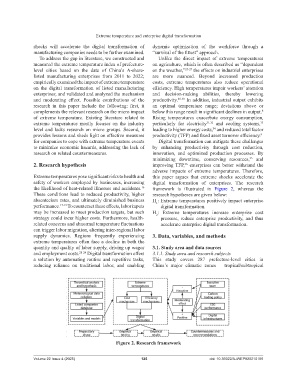
                2. Research hypothesis                              improving TFP,  enterprises can  better  withstand  the
                                                                                  36
                                                                    adverse impacts of extreme  temperatures.  Therefore,
                Extreme temperatures pose significant risks to health and   this paper argues that  extreme shocks accelerate  the
                safety of workers employed by businesses, increasing   digital  transformation of enterprises.  The research
                the likelihood of heat-related illnesses and accidents.    framework is illustrated  in  Figure  2, whereas the
                                                               16
                These conditions lead to reduced productivity, higher   research hypotheses are given below:
                absenteeism rates, and ultimately diminished business   H : Extreme temperatures positively impact enterprise
                performance. 17-19  To counteract these effects, labor inputs   1  digital transformation.
                may be increased to meet production targets, but such   H : Extreme  temperatures  increase  enterprise  cost
                strategy could incur higher costs. Furthermore, health-  2  pressure, reduce enterprise productivity, and thus
                related concerns and abnormal temperature fluctuations   accelerate enterprise digital transformation.
                can trigger labor migration, altering inter-regional labor
                supply  dynamics.  Regions  frequently  experiencing   3. Data, variables, and methods
                extreme temperatures often face a decline in both the
                quantity and quality of labor supply, driving up wages   3.1. Study area and data sources
                and employment costs. 20-24  Digital transformation offers   3.1.1. Study area and research subjects
                a solution by automating routine and repetitive tasks,   This  study  covers 287 prefecture-level  cities  in
                reducing reliance  on traditional  labor, and enabling   China’s major climatic  zones – tropical/subtropical


                                                    Figure 2. Research framework


                Volume 22 Issue 4 (2025)                       125                           doi: 10.36922/AJWEP025210166

