


Page 135 - AJWEP-22-4
P. 135
Extreme temperature and enterprise digital transformation

                3.3.2. Core explanatory variable                    shareholder),  independent  director  size  (Indep,
                The incidence rate of extreme temperatures, including   measured  by the  number of  independent  directors),
                extreme  high and extreme  low temperatures,  was   Big Four audit (Big4, assigned a value of 1 if audited
                measured in terms of the duration of extreme weather   by one of the Big Four accounting firms, otherwise 0),
                in the city, which was determined  in accordance  to   audit opinion (Opinion, assigned a value of 1 if the
                published methods. 20,34  A  fixed  threshold  method  was   opinion  is  standard  unqualified,  otherwise  0),  and
                used, with 35°C and −5°C as the criteria: if the daily   internal  control  index  (IC,  measured  by  the  firm’s
                maximum temperature exceeded 35°C, it was included   internal control index); the macroeconomic control
                in the number of extreme-high-temperature days, while   variables include economic development level (GDP,
                below −5°C, it was included in the number of extreme-  measured  by  the  natural  logarithm  of  city  GDP),
                low-temperature days, which was eventually summed   education level (EDU, measured by the proportion
                up to obtain the specific value of the number of days of   of the population with higher education in the city),
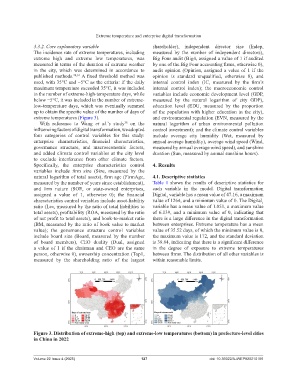
                extreme temperatures (Figure 3).                    and environmental regulation (EVN, measured by the
                  With reference to  Wang  et al.’s study  on the   natural logarithm of urban environmental pollution
                                                        38
                influencing factors of digital transformation, we adopted   control investment); and the climate control variables
                four categories of control variables for this study:   include average city humidity (Wet, measured by
                enterprise  characteristics,  financial  characteristics,   annual average humidity), average wind speed (Wind,
                governance structure, and macroeconomic factors,    measured by annual average wind speed), and sunshine
                and added climate control variables at the city level   duration (Sun, measured by annual sunshine hours).
                to exclude interference from other climate factors.
                Specifically,  the  enterprise  characteristics  control   4. Results
                variables  include  firm  size  (Size,  measured  by  the
                natural logarithm of total assets), firm age (FirmAge,   4.1. Descriptive statistics
                measured by the number of years since establishment),   Table  1 shows the  results  of descriptive  statistics  for
                and  firm  nature  (SOE,  or  state-owned  enterprises,   each  variable  in  the  model.  Digital  transformation
                assigned  a  value  of  1,  otherwise  0);  the  financial   Digital  variable has a mean value of 47.16, a maximum
                                                                          1
                characteristics control variables include asset-liability   value of 1264, and a minimum value of 0. The Digital
                                                                                                                    1
                ratio (Lev, measured by the ratio of total liabilities to   variable has a mean value of 1.051, a maximum value
                total assets), profitability (ROA, measured by the ratio   of 6.139, and a minimum  value  of 0, indicating  that
                of net profit to total assets), and book-to-market ratio   there is a large difference in the digital transformation
                (BM, measured by the ratio of book value to market   between enterprises. Extreme temperature has a mean
                value); the governance structure control variables   value of 35.52 days, of which the minimum value is 0,
                include board size (Board, measured by the number   the maximum value is 172, and the standard deviation
                of board members), CEO duality (Dual, assigned      is 39.64, indicating that there is a significant difference
                a value of 1 if the chairman and CEO are the same   in the degree of exposure to extreme temperatures
                person, otherwise 0), ownership concentration (Top1,   between firms. The distribution of all other variables is
                measured  by  the  shareholding  ratio  of  the largest   within reasonable limits.


                Figure 3. Distribution of extreme-high (top) and extreme-low temperatures (bottom) in prefecture-level cities
                in China in 2022


                Volume 22 Issue 4 (2025)                       127                           doi: 10.36922/AJWEP025210166

