


Page 33 - AJWEP-22-5
P. 33
Heterogeneous catalysts for biodiesel production

                 Table 8. (Continued)
                 Source         Catalyst               Loading    Time   Temperature  Molar-to-oil   Yield   References
                                                        (wt%)      (h)       (°C)        ratio      (%)
                 Cerbera        Coconut husk             10         3         60          6:1       88.6      377
                 manghas
                 Palm oil       Eggshell                  7         4         65          9:1       91.5      378
                 Canola         Harwood                   5         3         65          18:1     89 – 92    379
                 Wood           Canola                    5         3        150          6:1        48       380
                 Frying oil     Rice husk                 5         15       110          20:1      87.6      381
                 Palm fatty acid   Palm waste            2.5        2         60          9:1       96.1      382
                 distillate
                 Oleic acid     Corn straw                7         4         60          7:1        98       383
                 Palm oil       Palm oil trunk            2        0.75       65           -         93       384
                                Sugarcane bagasse         2        0.75       65           -         94       385


                method,  and  reaction  conditions  on  biodiesel  yield.   mild reaction settings. In contrast to other heterogeneous
                The use of biomass-derived heterogeneous catalysts   catalysts, CaO has been shown to exhibit a reduced rate
                not  only  enhances  biodiesel  production  efficiency   of reactivity. 390
                but also promotes the utilization of renewable and     For the manufacture of biodiesel, CaO has been
                waste materials, contributing to sustainable energy   employed  as an alkaline  solid catalyst  in several
                solutions.                                          experiments.  Research has shown that CaO is a viable
                                                                               391
                                                                    choice  for recyclable  catalysts  since it  is extremely
                6.1. Heterogeneous solid catalysts derived from     soluble in methanol.  In addition, other research has
                                                                                       392
                biomass                                             looked at biodiesel production using various feedstocks,
                Alkali metals, metal oxides, and alkaline earth metals   including soybeans, and catalysts with mixed oxide
                are examples of heterogeneous catalysts that are    heterogeneity, including  calcium-doped  silicates.
                frequently employed in the manufacture of biodiesel.   Mesoporous calcium  silicate  and pectin  methyl
                                                                                               393
                These catalysts are frequently accompanied by pre-  esterase-templated  calcium  structures (PMCS1-9)
                cursors that offer a large surface area.  Since solid   are notable CaO catalysts that incorporate silicates as
                                                   386
                acid catalysts provide several active sites with both   references.
                Lewis  and  Brønsted  acidity,  they  are  preferred  over
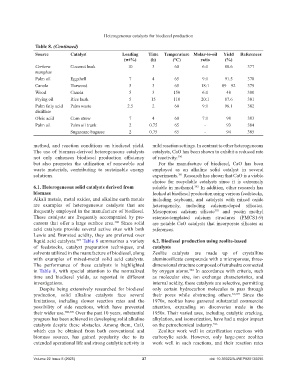
                liquid acid catalysts.  Table 8 summarizes a variety   6.2. Biodiesel production using zeolite-based
                                   387
                of feedstocks, catalyst preparation techniques, and   catalysts
                solvents utilized in the manufacture of biodiesel, along   Zeolite  catalysts are made up of crystalline
                with examples of mixed-metal solid acid catalysts.   aluminosilicate compounds with a microporous, three-
                The  performance  of  these  catalysts  is  highlighted   dimensional structure composed of tetrahedra connected
                in  Table  8, with special attention to the normalized   by oxygen atoms.  In accordance with criteria, such
                                                                                    394
                time  and  biodiesel  yields,  as  reported  in  different   as molecular  size,  ion  exchange  characteristics,  and
                investigations.                                     internal acidity, these catalysts are selective, permitting
                  Despite  being  extensively  researched  for  biodiesel   only certain hydrocarbon molecules  to pass through
                production,  solid alkaline  catalysts  face  several   their  pores  while  obstructing  others. 64,395  Since the
                limitations,  including slower reaction  rates and the   1970s, zeolites  have garnered substantial  commercial
                possibility  of side reactions,  which have prevented   attention,  expanding  on  discoveries  made  in  the
                their wider use. 388,389  Over the past 10 years, substantial   1950s. Their varied uses, including catalytic cracking,
                progress has been achieved in developing solid alkaline   alkylation, and isomerization, have had a major impact
                catalysts despite these obstacles. Among them, CaO,   on the petrochemical industry. 396
                which can be obtained from both conventional  and      Zeolites  work  well  in  esterification  reactions  with
                biomass sources, has gained popularity  due to its   carboxylic  acids. However, only  large-pore  zeolites
                extended operational life and strong catalytic activity in   work  well in such reactions, and their reaction rates


                Volume 22 Issue 5 (2025)                        27                           doi: 10.36922/AJWEP025130095

