


Page 35 - AJWEP-22-5
P. 35
Heterogeneous catalysts for biodiesel production

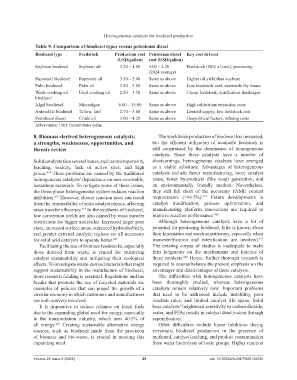
                 Table 9. Comparison of biodiesel types versus petroleum diesel
                 Biodiesel type     Feedstock       Production cost  Petroleum diesel  Key cost drivers
                                                     (USD/gallon)  cost (USD/gallon)
                 Soybean biodiesel  Soybean oil       3.20 – 4.80  3.00 – 4.20     Feedstock (80% of cost), processing
                                                                   (2024 average)
                 Rapeseed biodiesel  Rapeseed oil     3.50 – 5.00  Same as above   Higher oil yield than soybean
                 Palm biodiesel     Palm oil          2.80 – 3.80  Same as above   Low feedstock cost; sustainability issues
                 Waste cooking oil   Used cooking oil  2.50 – 3.50  Same as above  Cheap feedstock; purification challenges
                 biodiesel
                 Algal biodiesel    Microalgae       8.00 – 15.00  Same as above   High cultivation/extraction costs
                 Animal fat biodiesel  Tallow, lard   2.70 – 3.60  Same as above   Limited supply; low feedstock cost
                 Petroleum diesel   Crude oil         3.00 – 4.20  Same as above   Geopolitical factors, refining costs
                 Abbreviation: USD: United States dollar.
                8. Biomass-derived heterogeneous catalysts:            The worldwide production of biodiesel has increased,
                a strengths, weaknesses, opportunities, and         but  the  efficient  utilization  of  available  feedstock  is
                threats review                                      still  constrained by the  dominance  of homogeneous
                                                                    catalysts. Since these catalysts have a number of
                Solid catalysts face several issues, such as microporosity,   shortcomings, heterogeneous catalysts have emerged
                leaching,  toxicity, lack  of active  sites, and high   as  a  viable  substitute.  Advantages  of heterogeneous
                prices.  These problems are caused by the traditional   catalysts  include  faster  manufacturing,  more  catalyst
                      414
                homogeneous catalysts’ dependence on non-renewable,   reuse, fewer by-products (like soap) generation,  and
                hazardous materials. To mitigate some of these issues,   an environmentally  friendly  method.  Nevertheless,
                the three-phase heterogeneous system reduces reaction   they still fall short of the necessary FAME  content
                inhibition.  However, slower reaction rates can result   requirements  (>96.5%).  Future  developments  in
                                                                                          419
                         415
                from the immiscibility of solid catalyst phases, affecting   catalyst  modification,  process  optimization,  and
                mass transfer efficiency.  In the synthesis of biodiesel,   manufacturing  platform  innovations are required to
                                     416
                low conversion yields are also caused by mass transfer   improve reaction performance. 420
                restrictions for bigger molecules. Increased larger pore   Although heterogeneous  catalysts  have  a lot  of
                sizes, increased surface areas, enhanced hydrophobicity,   potential for producing biodiesel, little is known about
                and greater external catalytic regions are all necessary   their kinematics and reaction pathways, especially when
                for solid acid catalysts to operate better. 417     transesterification  and  esterification  are  involved.
                                                                                                                   421
                  Facilitating the use of biomass feedstocks, especially   The existing  corpus of studies is inadequate  to make
                those derived from waste, is crucial  for enhancing   firm  judgments  on  the  mechanisms  and  kinetics  of
                catalyst  sustainability  and  mitigating  their  ecological   these  catalysts.  Hence,  further  thorough  research  is
                                                                                  422
                effects. To investigate waste-derived materials that might   required to counterbalance the present emphasis on the
                support sustainability in the manufacture of biodiesel,   advantages and disadvantages of these catalysts.
                more research funding is essential. Regulations and tax   The  difficulties  with  homogeneous  catalysts  have
                breaks that promote the use of recycled materials are   been thoroughly studied, whereas heterogeneous
                examples  of policies  that  can  propel  the  growth of a   catalysts  remain  relatively  new. Important  problems
                circular economy in which customers and manufacturers   that  need to be addressed include  instability, poor
                are both actively involved.                         reaction rates, and limited  catalyst life spans. Solid
                  It is imperative  to reduce  reliance  on fossil fuels   base catalysts’ heightened sensitivity to carbon dioxide,
                due to the expanding global need for energy, especially   water, and FFAs results in catalyst deactivation through
                in the transportation industry, which uses 40.5% of   saponification.
                all  energy.  Creating  sustainable  alternative  energy   Other  difficulties  include  lipase  inhibition  during
                         418
                sources, such as biodiesel made from the provision   enzymatic  biodiesel  production  in  the  presence  of
                of biomass and bio-waste, is crucial  in meeting  this   methanol, catalyst leaching, and product contamination
                expanding need.                                     from water hydrolysis of ionic groups. Higher reaction


                Volume 22 Issue 5 (2025)                        29                           doi: 10.36922/AJWEP025130095

