


Page 74 - AJWEP-22-5
P. 74
Jun, et al.

                crossover, and selection operations inspired by natural   In summary, Nadam and DE exhibit complementary
                selection. In the mutation stage, DE perturbs the current   optimization  characteristics.  Nadam  is  suitable
                individual  using  difference  vectors  randomly  selected   for  continuous  optimization  problems  with  known
                from the population  to form an exploratory  mutation   gradients and offers excellent local convergence speed,
                vector. During the crossover stage, the mutation vector   while  DE  is  capable  of  conducting  large-scale  global
                is combined with the current individual according to a   searches  without  requiring  gradient  data.  Combining
                specified  probability,  ensuring  diversity  in  the  search   the two allows for the generation of high-quality global
                process. In the  selection  stage,  the  algorithm  retains   initial solutions via DE, followed by accelerated local
                individuals with better fitness values to proceed to the   convergence in the solution space through Nadam.
                next  generation.  This  strategy  enables  DE  to  exhibit   This  hybrid  strategy  improves  both  the  accuracy
                strong  global  search  capabilities  without  relying  on   and  efficiency  of  the  overall  optimization  process.  It
                gradient information, making it particularly suitable for   enhances  robustness,  reduces  the  risk  of  becoming
                complex, non-convex, or non-differentiable problems.  trapped  in  local  optima,  and  is  of  great  significance
                  However,  the  local  development  ability  of  DE  is   for  solving  complex,  high-dimensional  optimization
                relatively  weak.   Once  the  solution  space  begins  to   problems.
                              24
                converge,  it  often  lacks  a  fine  search  mechanism.
                Moreover, the computational  cost  associated  with   3.2. Design of hybrid algorithms and IEM
                population-based  evolution  can  be  relatively  high.   To fully leverage the strengths of Nadam and DE,
                Specifically,  in  the  mutation  stage,  three  distinct   this  study  proposes  a  hybrid  optimization  algorithm
                individuals, x , x , x  are selected from the population   that integrates the fast local convergence capability of
                            r1
                               r2
                                  r3
                to construct a difference vector. The mutation vector is   Nadam with the strong global search ability of DE. In
                generated as follows:                               this framework, the overall population was divided into
                                                                    two subpopulations: one employed the Nadam algorithm
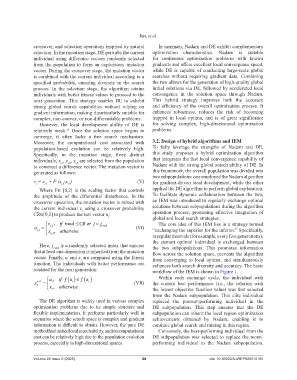
                v  = x  + F⋅(x -x )                           (V)   for gradient-driven local development, while the other
                               r3
                            r2
                 i
                     r1
                  Where  F∈ [0,2] is the scaling  factor  that  controls   applied the DE algorithm to perform global exploration.
                the  amplitude  of  the  differential  disturbance.  In  the   To  facilitate  dynamic  collaboration  between  the  two,
                crossover operation, the mutation vector is mixed with   an IEM was introduced to regularly exchange optimal
                the current individual x  using a crossover probability   solutions between subpopulations during the algorithm
                                     i
                CR∈[0,1] to produce the test vector u :             operation  process,  promoting  effective  integration  of
                                                 i
                                                                    global and local search strategies.
                      v ,  ifrand  CRorj   j                        The core idea of this IEM lies in a strategy termed

                u    ij,                    rand           (VI)   “exchanging the superior for the inferior.” Specifically,
                 ij,
                       x ,  otherwise
                       ij,
                                                                    at regular intervals (for example, every five generations),
                                                                    the  current  optimal  individual  is  exchanged  between
                  Here, j rand  is a randomly selected index that ensures   the  two  subpopulations.  This  promotes  information
                that at least one dimension is inherited from the mutation   flow across the solution space, prevents the algorithm
                vector. Finally, u  and x  are compared using the fitness   from  converging  to  local  optima,  and  simultaneously
                                     i
                               i
                function. The individuals with better performance are   enhances both search diversity and accuracy. The basic
                retained for the next generation:                   workflow of the IEM is shown in Figure 1.
                                     f x
                       u ,  iff u                                Within  each  exchange  cycle,  the  individual  with

                x i t1     i  i      i                   (VII)   the  current  best  performance  (i.e.,  the  solution  with
                        x ,  otherwise                            the lowest objective function value) was first selected
                        i
                                                                    from  the  Nadam  subpopulation.  This  elite  individual
                  The DE algorithm is widely used in various complex   replaced  the  poorest-performing  individual  in  the
                optimization  problems  due  to  its  simple  structure  and   DE  subpopulation.  This  step  ensures  that  the  DE
                flexible implementation. It performs particularly well in   subpopulation can inherit the local region optimization
                scenarios where the search space is complex and gradient   achievements  obtained  by  Nadam,  enabling  it  to
                information is difficult to obtain. However, the pure DE   continue global search and mining in this region.
                method has limited local search ability, and its computational   Conversely, the best-performing individual from the
                cost can be relatively high due to the population evolution   DE  subpopulation  was  selected  to  replace  the  worst-
                process, especially in high-dimensional spaces.     performing  individual  in  the  Nadam  subpopulation.


                Volume 22 Issue 5 (2025)                        68                           doi: 10.36922/AJWEP025210165

