


Page 78 - AJWEP-22-5
P. 78
Jun, et al.

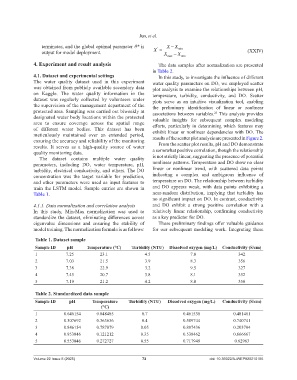
                   terminates, and the global optimal parameter θ* is   '  XX  min
                                                                            −
                   output for model deployment.                      X =  X max  − X min                      (XXIV)
                4. Experiment and result analysis                      The data samples after normalization are presented
                                                                    in Table 2.
                4.1. Dataset and experimental settings                 In this study, to investigate the influence of different
                The water quality dataset used in this experiment   water quality parameters on DO, we employed scatter
                was obtained from publicly available secondary data   plot analysis to examine the relationships between pH,
                on Kaggle.  The water quality information in the    temperature,  turbidity,  conductivity,  and  DO.  Scatter
                dataset  was  regularly  collected  by  volunteers  under   plots  serve  as  an  intuitive  visualization  tool,  enabling
                the supervision of the management department of the   the  preliminary  identification  of  linear  or  nonlinear
                protected area. Sampling was carried out biweekly at   associations between variables.  This analysis provides
                                                                                               25
                designated water body locations within the protected   valuable  insights  for  subsequent  complex  modeling
                area to ensure coverage across the spatial range    efforts,  particularly  in  determining  which  features  may
                of  different  water  bodies.  This  dataset  has  been
                meticulously  maintained  over  an  extended  period,   exhibit linear or nonlinear dependencies with DO. The
                ensuring the accuracy and reliability of the monitoring   results of the scatter plot analysis are presented in Figure 2.
                results. It serves as a high-quality source of water   From the scatter plot results, pH and DO demonstrate
                quality monitoring data.                            a somewhat positive correlation, though the relationship
                  The dataset contains multiple water quality       is not strictly linear, suggesting the presence of potential
                parameters, including DO, water temperature, pH,    nonlinear patterns. Temperature and DO show no clear
                turbidity, electrical conductivity, and others. The DO   linear  or nonlinear  trend,  with  scattered  data  points
                concentration  was  the  target  variable  for  prediction,   indicating  a  complex  and  ambiguous  influence  of
                and other parameters were used as input features to   temperature on DO. The relationship between turbidity
                train the LSTM model. Sample entries are shown in   and  DO  appears  weak,  with  data  points  exhibiting  a
                Table 1.                                            near-random  distribution,  implying  that  turbidity  has
                                                                    no significant impact on DO. In contrast, conductivity
                4.1.1. Data normalization and correlation analysis  and  DO  exhibit  a  strong  positive  correlation  with  a
                In  this  study,  Min-Max  normalization  was  used  to   relatively  linear  relationship,  confirming  conductivity
                standardize the dataset, eliminating differences across   as a key predictor for DO.
                eigenvalue  dimensions  and  ensuring  the  stability  of   These preliminary findings offer valuable guidance
                model training. The normalization formula is as follows:  for  our  subsequent  modeling  work.  Integrating  these

                 Table 1. Dataset sample
                 Sample ID     pH      Temperature (°C)    Turbidity (NTU)  Dissolved oxygen (mg/L)  Conductivity (S/cm)
                 1            7.25           23.1                4.5                 7.8                  342
                 2            7.03           21.5                3.9                 8.3                  356
                 3            7.38           22.9                3.2                 9.5                  327
                 4            7.45           20.7                3.8                 8.1                  352
                 5            7.19           21.2                4.2                 8.8                  350


                 Table 2. Standardized data sample
                 Sample ID      pH        Temperature     Turbidity (NTU)  Dissolved oxygen (mg/L)  Conductivity (S/cm)
                                              (°C)
                 1           0.646154       0.848485            0.7               0.461538              0.481481
                 2           0.307692       0.363636            0.4               0.589744              0.740741
                 3           0.846154       0.787879           0.05               0.897436              0.203704
                 4           0.953846       0.121212           0.35               0.538462              0.666667
                 5           0.553846       0.272727           0.55               0.717949              0.62963


                Volume 22 Issue 5 (2025)                        72                           doi: 10.36922/AJWEP025210165

