


Page 80 - AJWEP-22-5
P. 80
Jun, et al.

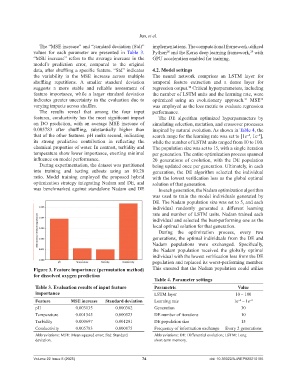
                  The “MSE increase” and “standard deviation (Std)”   implementations. The computational framework utilized
                values  for each  parameter  are  presented  in  Table  3.   Python  and the Keras deep learning framework,  with
                                                                                                               29
                                                                          28
                “MSE increase”  refers  to  the  average  increase  in  the   GPU acceleration enabled for training.
                model’s prediction  error, compared to the original
                data, after shuffling a specific feature. “Std” indicates   4.2. Model settings
                the  variability  in  the  MSE  increase  across  multiple   The neural network comprises an LSTM layer  for
                shuffling  repetitions.  A  smaller  standard  deviation   temporal  feature  extraction  and a dense layer  for
                suggests a  more  stable  and  reliable  assessment  of   regression output.  Critical hyperparameters, including
                                                                                    30
                feature  importance,  while  a  larger  standard  deviation   the number of LSTM units and the learning rate, were
                indicates greater uncertainty  in the evaluation  due to   optimized  using  an  evolutionary  approach.  MSE
                                                                                                                    32
                                                                                                             31
                varying impacts across shuffles.                    was employed as the loss metric to evaluate regression
                  The results reveal that among the four input      performance.
                features, conductivity has the most significant impact   The  DE  algorithm  optimized  hyperparameters  by
                on  DO prediction,  with  an  average  MSE increase  of   simulating selection, mutation, and crossover processes
                0.005783  after  shuffling,  substantially  higher  than   inspired by natural evolution. As shown in Table 4, the
                that of the other features. pH ranks second, indicating   search range for the learning rate was set to [1e , 1e ],
                                                                                                              −4
                                                                                                                  −2
                its  strong  predictive  contribution  in  reflecting  the   while the number of LSTM units ranged from 10 to 100.
                chemical properties of water. In contrast, turbidity and   The population size was set to 15, with a single iteration
                temperature show lower importance, exerting minimal   per generation. The entire optimization process spanned
                influence on model performance.                     20 generations  of evolution,  with  the  DE population
                  During experimentation, the dataset was partitioned   being updated once per generation. Ultimately, in each
                into  training  and  testing  subsets  using  an  80:20   generation,  the DE algorithm  selected  the individual
                ratio.  Model  training  employed  the  proposed  hybrid   with the lowest verification loss as the global optimal
                optimization strategy integrating Nadam and DE, and   solution of that generation.
                was  benchmarked  against  standalone  Nadam  and  DE   In each generation, the Nadam optimization algorithm
                                                                    was used to train the model individuals generated by
                                                                    DE. The Nadam population size was set to 5, and each
                                                                    individual  randomly  generated  a  different  learning
                                                                    rate and number of LSTM units. Nadam trained each
                                                                    individual and selected the best-performing one as the
                                                                    local optimal solution for that generation.
                                                                       During  the  optimization  process,  every  two
                                                                    generations, the optimal individuals from the DE and
                                                                    Nadam  populations  were  exchanged.  Specifically,
                                                                    the  Nadam  population  received  the  globally  optimal
                                                                    individual with the lowest verification loss from the DE
                                                                    population and replaced its worst-performing member.
                Figure 3. Feature importance (permutation method)   This ensured that the Nadam population could utilize
                for dissolved oxygen prediction
                                                                     Table 4. Parameter settings
                 Table 3. Evaluation results of input feature        Parametric                           Value
                 importance                                          LSTM layer                          10 – 100

                 Feature        MSE increase   Standard deviation    Learning rate                      1e  – 1e −2
                                                                                                          −4
                 pH               0.003135          0.000362         Generation                            30
                 Temperature      0.001345          0.000523         DE number of iterations               10
                 Turbidity        0.000697          0.001291         DE population size                    15
                 Conductivity     0.005783          0.000875         Frequency of information exchange  Every 2 generations
                 Abbreviations: MSE: Mean squared error; Std: Standard   Abbreviations: DE: Differential evolution; LSTM: Long
                 deviation.                                          short-term memory.


                Volume 22 Issue 5 (2025)                        74                           doi: 10.36922/AJWEP025210165

