


Page 34 - AJWEP-22-6
P. 34
Fattorini

                intentionally  released  into  the  Persian  Gulf,  igniting   diversity  of organisms, such as ostracods. Mangrove
                hundreds of oil wells in Kuwait.  The spill primarily   forests along the Saudi coast were also damaged, with
                involved crude oil, with initial estimates ranging from   nearly half affected and one-third killed, though some
                approximately 270,000 to 1.5 million tons. The oil slick   natural  regeneration  occurred.  It  has been  estimated
                reached a maximum size of over 10,000 km  and was up   that the full recovery from the Gulf War oil pollution
                                                      2
                to 13 cm thick in some areas. The disaster affected around   will take several decades, with some areas, such as salt
                600–700 km of the Saudi Arabian coastline, including   marshes, showing slower recovery.  Although  some
                                                                                                     85
                sandy beaches, gravel shores,  wetlands, lagoons, and   areas,  such  as  rocky  beaches  and  mangroves,  have
                muddy  tidal  flats.  Kuwait,  Iran,  Bahrain,  and  Qatar   fully recovered within a few years, the more sensitive
                also experienced some oil contamination. The general   ecosystems, due to their anaerobic nature and lack of
                extent  of  the  disaster  was  significant,  halting  fishing   physical action, will require a longer time, which is still
                and prawn industries in the Gulf due to contamination.   difficult to quantify. 85,86
                Oil penetrated sediments to 10–50 cm depths, slowing   The events here described can be considered the most
                natural  degradation.   Widespread mortality  among   significant in terms of volumes of hydrocarbon mixtures
                                  85
                various marine species was registered. Nearly 30,000   released  into the marine  environment  and impact  on
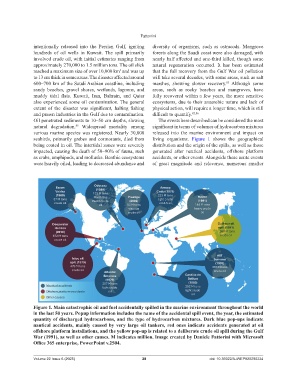
                seabirds, primarily grebes and cormorants, died from   living  organisms.  Figure  1  shows the geographical
                being coated in oil. The intertidal zones were severely   distribution and the origin of the spills, as well as those
                impacted, causing the death of 50–90% of fauna, such   generated  after  nautical  accidents,  offshore  platform
                as crabs, amphipods, and mollusks. Benthic ecosystems   accidents, or other events. Alongside these acute events
                were heavily oiled, leading to decreased abundance and   of great magnitude  and relevance,  numerous smaller


                Figure 1. Main catastrophic oil and fuel accidentally spilled in the marine environment throughout the world
                in the last 50 years. Popup information includes the name of the accidental spill event, the year, the estimated
                quantity of discharged hydrocarbons, and the type of hydrocarbon mixtures. Dark blue pop-ups indicate
                nautical accidents, mainly caused by very large oil tankers, red ones indicate accidents generated at oil
                offshore platform installations, and the yellow pop-up is related to a deliberate crude oil spill during the Gulf
                War (1991), as well as other causes. M indicates million. Image created by Daniele Fattorini with Microsoft
                Office 365 enterprise, PowerPoint v.2504.


                Volume 22 Issue 6 (2025)                        28                           doi: 10.36922/AJWEP025290224

