


Page 36 - AJWEP-22-6
P. 36
Fattorini

                dry deposition (particulate matter). While often at low   Despite  regulations  and increasing  awareness,
                concentrations, the vastness of the ocean surface makes   illegal  dumping  of  oil  and  oily  waste  significantly
                atmospheric deposition a significant contributor to the   contributes  to  marine  hydrocarbon  pollution.  This
                global hydrocarbon budget in seawater, especially for   includes  the deliberate  discharge of bilge  water, tank
                volatile and semi-volatile compounds. 42,71,72  Estimating   cleaning residues, and even spent lubricating oils from
                the global annual volume of hydrocarbons released   smaller  vessels  or  less  regulated  operations.  Satellite
                into the environment through atmospheric transfer and   surveillance  has revealed  the  prevalence  of illegal
                deposition is a complex task due to several factors,   dumping, particularly  in busy shipping lanes and
                including the vast array of hydrocarbon compounds,   areas with lax enforcement. Some reports suggest that
                their varying atmospheric lifetimes, diverse emission   thousands of cases of illegal dumping of hydrocarbons
                sources (both natural and anthropogenic), and the   occur in European seas alone every year, collectively
                challenges  of  global  monitoring  and  modeling.   exceeding  the  inputs  from  major  tanker  accidents.
                                                                                                                    87
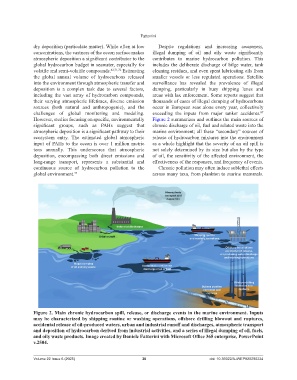
                However, studies focusing on specific, environmentally   Figure 2 summarizes and outlines the main sources of
                significant  groups,  such  as  PAHs  suggest  that   chronic discharge of oil, fuel and related waste into the
                atmospheric deposition is a significant pathway to their   marine environment; all these “secondary” sources of
                ecosystem entry.  The estimated global atmospheric   release of hydrocarbon mixtures into the environment
                input of PAHs to the ocean is over 1 million metric   as a whole highlight that the severity of an oil spill is
                tons annually.  This underscores that atmospheric   not solely determined by its size but also by the type
                deposition, encompassing both direct emissions and   of oil, the sensitivity of the affected environment, the
                long-range transport, represents a substantial and   effectiveness of the responses, and frequency of events.
                continuous  source  of  hydrocarbon  pollution  to  the   Chronic pollution may often induce sublethal effects
                global environment. 42                              across many taxa, from plankton to marine mammals.


                Figure 2. Main chronic hydrocarbon spill, release, or discharge events in the marine environment. Inputs
                may be characterized by shipping routine or washing operations, offshore drilling blowout and ruptures,
                accidental release of oil-produced waters, urban and industrial runoff and discharges, atmospheric transport
                and deposition of hydrocarbon derived from industrial activities, and a series of illegal dumping of oil, fuels,
                and oily waste products. Image created by Daniele Fattorini with Microsoft Office 365 enterprise, PowerPoint
                v.2504.


                Volume 22 Issue 6 (2025)                        30                           doi: 10.36922/AJWEP025290224

