


Page 37 - AJWEP-22-6
P. 37
Hydrocarbons in seawater

                Affected  species  experience  impaired  growth  and   to the coast. 88-90  As mentioned above, regional variability
                reproduction,  immune  suppression, developmental   significantly   modulates   hydrocarbon   dynamics
                abnormalities,  and behavioral  changes.  Long-term   in  marine  environments,  influencing  oil  density,
                ecosystem disruption, including habitat degradation of   dispersion, spreading, and emulsification. Based on this
                vital coastal areas, such as mangroves and coral reefs,   perspective, there is no unified fate of hydrocarbons in
                and bioaccumulation  within the food web, severely   the oceans, as cold, temperate, or tropical environments
                threatens ecosystem health and biodiversity. Species,   can  significantly  alter  the  extent  and  speed  of  the
                such as seabirds,  marine  mammals  (e.g.,  dolphins,   chemical–physical and biological phenomena at play.
                                                                                                                   1,2
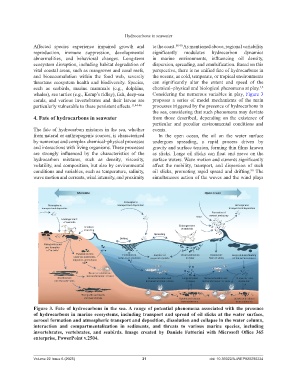
                whales), sea turtles (e.g., Kemp’s ridley), fish, deep-sea   Considering the numerous variables in play, Figure 3
                corals,  and  various invertebrates  and  their  larvae  are   proposes a  series  of model  mechanisms  of the  main
                particularly vulnerable to these persistent effects. 11,44-46  processes triggered by the presence of hydrocarbons in
                                                                    the sea, considering that such phenomena may deviate
                4. Fate of hydrocarbons in seawater                 from those described, depending on the existence  of
                                                                    particular  and peculiar  environmental  conditions  and
                The fate of hydrocarbon mixtures in the sea, whether   events.
                from natural or anthropogenic sources, is characterized   In the  open  ocean,  the  oil  on the  water  surface
                by numerous and complex chemical–physical processes   undergoes spreading,  a rapid process driven by
                and interactions with living organisms. These processes   gravity and surface tension, forming thin films known
                are  strongly  influenced  by  the  characteristics  of  the   as  slicks.  Large  oil  slicks  can  float  and  move  on  the
                hydrocarbon mixtures, such as density, viscosity,   surface waters. Wave motion and currents significantly
                volatility, and composition, but also by environmental   affect  the  mobility,  transport,  and  dispersion  of  such
                conditions and variables, such as temperature, salinity,   oil  slicks,  promoting  rapid  spread  and  drifting.  The
                                                                                                               90
                wave motion and currents, wind intensity, and proximity   simultaneous action of the waves and the wind plays


                Figure 3. Fate of hydrocarbons in the sea. A range of potential phenomena associated with the presence
                of hydrocarbons in marine ecosystems, including transport and spread of oil slicks at the water surface,
                aerosol formation and atmospheric transport and deposition, dissolution and collapse in the water column,
                interaction  and compartmentalization  in sediments, and threats to various marine species, including
                invertebrates,  vertebrates,  and  seabirds.  Image  created  by  Daniele  Fattorini  with  Microsoft  Office  365
                enterprise, PowerPoint v.2504.


                Volume 22 Issue 6 (2025)                        31                           doi: 10.36922/AJWEP025290224

