


Page 83 - AJWEP-22-6
P. 83
ML-based C for side trapezoidal labyrinth weirs
d
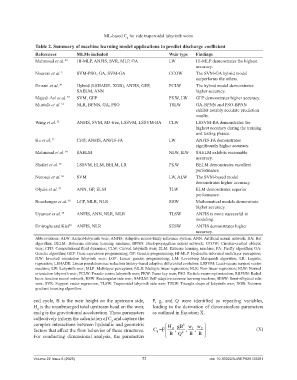
Table 2. Summary of machine learning model applications to predict discharge coefficient
References MLMs included Weir type Findings
Mahmoud et al. 28 HI-MLP, ANFIS, SVR, MLP, GA LW HI-MLP demonstrates the highest
accuracy.
Nourani et al. 3 SVM-PSO, GA, SVM-GA CCOW The SVM-GA hybrid model
outperforms the others.
Emami et al. 29 Hybrid (LSHADE- XGB), ANFIS, GEP, PCLW The hybrid model demonstrates
SAELM, ANN higher accuracy.
Majedi-Asl et al. 30 SVM, GEP PKW, LW GEP demonstrates higher accuracy.
Mustafa et al. 31 NLR, BPNN, GA, PSO TSLW GA-BPNN and PSO-BPNN
exhibit notably accurate prediction
results.
Wang et al. 32 ANFIS, SVM, M5-tree, LSSVM, LSSVM-BA CLW LSSVM-BA demonstrates the
highest accuracy during the training
and testing phases.
Hu et al. 33 CFD; ANFIS, ANFIS-FA LW ANFIS-FA demonstrates
significantly higher accuracy.
Mahmoud et al. 34 SAELM NLW, ILW SAELM exhibits reasonable
accuracy.
Shafiei et al. 35 LSSVM, ELM, BELM, LR PKW BELM demonstrates excellent
performance.
Norouzi et al. 36 SVM LW, ALW The SVM-based model
demonstrates higher accuracy.
Olyaie et al. 37 ANN, GP, ELM TLW ELM demonstrates superior
performance.
Roushangar et al. 38 LGP, MLR, NLR RSW Mathematical models demonstrate
higher accuracy.
Uyumaz et al. 39 ANFIS, ANN, NLR, MLR TLSW ANFIS is more successful in
modeling.
Emiroglu and Kisi 40 ANFIS, NLR SESW ANFIS demonstrates higher
accuracy.
Abbreviations: ALW: Arched-labyrinth weir; ANFIS: Adaptive neural-fuzzy inference system; ANN: Artificial neural network; BA: Bat
algorithm; BELM: Bayesian extreme learning machine; BPNN: Back-propagation neural network; CCOW: Circular-crested oblique
weir; CFD: Computational fluid dynamics; CLW: Curved labyrinth weir; ELM: Extreme learning machine; FA: Firefly algorithm; GA:
Genetic algorithm; GEP: Gene expression programming; GP: Genetic programming; HI-MLP: Hydraulic-informed multilayer perceptron;
ILW: Inverted orientation labyrinth weir; LGP: Linear genetic programming; LM: Levenberg–Marquardt algorithm; LR: Logistic
regression; LSHADE: Linear population size reduction history-based adaptive differential evolution; LSSVM: Least-square support vector
machine; LW: Labyrinth weir; MLP: Multilayer perceptron; MLR: Multiple linear regression; NLR: Non-linear regression; NLW: Normal
orientation labyrinth weir; PCLW: Pseudo-cosine labyrinth weir; PKW: Piano key weir; PSO: Particle swarm optimization; RBFNN: Radial
basis function neural network; RSW: Rectangular side weir; SAELM: Self‐adaptive extreme learning machine; SESW: Semi-elliptical side
weir; SVR: Support vector regression; TLSW: Trapezoidal labyrinth side weir; TSLW: Triangle shape of labyrinth weir; XGB: Extreme
gradient boosting algorithm.
end cycle, B is the weir height on the upstream side, P, g, and Q were identified as repeating variables,
H is the unsubmerged total upstream head on the weir, leading to the derivation of dimensionless parameters
d
and g is the gravitational acceleration. These parameters as outlined in Equation X.
collectively inform the calculation of C and capture the
d
complex interactions between hydraulic and geometric H gB 5 w w
factors that affect the flow behavior of these structures. C=F d , 2 , 1 , 2 (X)
d
For conducting dimensional analysis, the parameters B Q B B
Volume 22 Issue 6 (2025) 77 doi: 10.36922/AJWEP025120081

