


Page 101 - AN-2-2
P. 101
Advanced Neurology                                                 Inflammatory myopathies during COVID-19


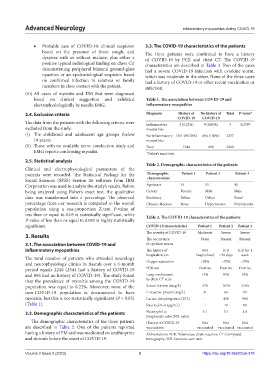
               •   Probable case of COVID-19: clinical suspicion   3.3. The COVID-19 characteristics of the patients
                   based  on  the  presence  of  fever,  cough,  and   The three patients were confirmed to have a history
                   dyspnea with or without malaise, plus  either a   of COVID-19 by PCR and chest CT. The COVID-19
                   positive typical radiological finding on chest CT   characteristics are described in Table 3. Two of the cases
                   demonstrating peripheral bilateral ground-glass   had  a  severe  COVID-19  infection  with  cytokine  storm,
                   opacities or an epidemiological suspicion based   which was moderate in the other. None of the three cases
                   on confirmed  infection in  relatives  or family   had a history of COVID-19 or other recent vaccination or
                   members in close contact with the patient.  infection.
            (iii) All cases of myositis and DM that were  diagnosed
               based on clinical suggestion and validated      Table 1. The association between COVID‑19 and
               electrophysiologically by needle EMG.           inflammatory myopathies

            2.4. Exclusion criteria                            Diagnosis     History of   No history of   Total  P‑value*
                                                                             COVID‑19  COVID‑19
            The data from the patients with the following criteria were   Inflammatory   3 (0.22%)  0 (0.00%)  3  0.2797
            excluded from the study:                           myopathies
            (i)  The childhood and adolescent age groups (below   No inflammatory  1341 (99.78%)  896 (100%)  2237
               18 years).                                      myopathies
            (ii)  Those with no available nerve conduction study and   Total   1344       896    2240
               EMG reports confirming myositis.                *Fisher’s exact test.

            2.5. Statistical analysis
                                                               Table 2. Demographic characteristics of the patients
            Clinical and electrophysiological parameters of the
            patients were recorded. The Statistical Package for the   Demographic   Patient 1   Patient 2   Patient 3
            Social Sciences (SPSS) version  26 software from IBM   characteristics
            Corporation was used to analyze the study’s results. Before   Age/years  34  53          40
            being analyzed using Fisher’s exact test, the qualitative   Gender  Female  Male         Male
            data was transformed into a percentage. The observed   Residency  Urban     Urban        Rural
            percentage from our research is compared to the overall   Chronic illnesses  None  Hypertension  Polymyositis
            population using a one-proportion Z-test.  P-value of
            less than or equal to 0.05 is statistically significant, while   Table 3. The COVID‑19 characteristics of the patients
            P-value of less than or equal to 0.001 is highly statistically
            significant.                                       COVID‑19 characteristics  Patient 1  Patient 2  Patient 3
                                                               The severity of COVID-19  Moderate  Severe  Severe
            3. Results
                                                               The occurrence         None     Present  Present
            3.1. The association between COVID-19 and          of cytokine storm
            inflammatory myopathies                            The history of          Not      ICU    ICU for 1
                                                               hospitalization      hospitalized  >30 days  week
            The total number of patients who attended neurology
            and neurophysiology clinics in Basrah over a 6-month   Oxygen saturation  >93%     <70%    <70%
            period equals 2240  (2344 had a history of COVID-19   PCR test            Positive  Positive  Positive
            and 896 had no history of COVID-19). The study found   Lung involvement    15%      50%     55%
            that the prevalence of myositis among the COVID-19   by chest CT scan
            population was equal to 0.22%. Moreover, none of the   Serum ferritin (mcg/L)  670  1650    2100
            non-COVID-19 population is documented to have      C-reactive protein (mg/L)  21    66      95
            myositis, but this is not statistically significant (P > 0.05)   Lactate dehydrogenase (U/L)  -  430  980
            (Table 1).                                         Interleukin-6 (pg/mL)    -       19      88
            3.2. Demographic characteristics of the patients   Neutrophil to           3.1      3.7     4.9
                                                               lymphocyte ratio (N/L ratio)
              The demographic characteristics of the three patients   History of COVID-19   Not   Not   Not
            are described in  Table 2. One of the patients reported   vaccination    vaccinated  vaccinated vaccinated
            having a history of PM and was medicated on azathioprine   Abbreviations: PCR: Polymerase chain reaction; CT: Computed
            and steroids before the onset of COVID-19.         tomography; ICR: Intensive care unit.


            Volume 2 Issue 2 (2023)                         3                          https://doi.org/10.36922/an.378

