


Page 102 - AN-2-2
P. 102
Advanced Neurology                                                 Inflammatory myopathies during COVID-19


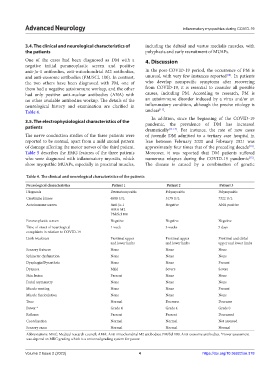
            3.4. The clinical and neurological characteristics of   including the deltoid and vastus medialis muscles, with
            the patients                                       polyphasia and early recruitment of MUAPs.
            One of the cases had been diagnosed as DM with a   4. Discussion
            negative initial paraneoplastic screen and positive
            anti-Jo-1 antibodies, anti-mitochondrial M2 antibodies,   In the post-COVID-19 period, the occurrence of PM is
                                                                                                 [10]
            and anti-exosome antibodies (PM/SCL 100). In contrast,   unusual, with very few instances reported . In patients
            the two others have been diagnosed with PM, one of   who develop nonspecific symptoms after recovering
            them had a negative autoimmune workup, and the other   from COVID-19, it is essential to consider all possible
            had only positive anti-nuclear antibodies (ANA) with   causes, including PM. According to research, PM is
            no other available antibodies workup. The details of the   an autoimmune disorder induced by a virus and/or an
            neurological history and examination are clarified in   inflammatory condition, although the precise etiology is
                                                                     [11]
            Table 4.                                           unclear .
                                                                 In  addition,  since  the  beginning  of  the  COVID-19
            3.5. The electrophysiological characteristics of the   pandemic, the prevalence of DM has increased
            patients                                           dramatically [12-14] . For instance, the rate  of  new cases
            The nerve conduction studies of the three patients were   of juvenile DM admitted to a tertiary care hospital in
            reported to be normal, apart from a mild axonal pattern   Iran between February 2020 and February 2021 was
            of damage affecting the motor nerves of the third patient.   approximately four times that of the preceding decade .
                                                                                                           [13]
            Table 5 describes the EMG features of the three patients   Moreover, it was reported that DM patients suffered
            who were diagnosed with inflammatory myositis, which   numerous relapses during the COVID-19 pandemic .
                                                                                                           [15]
            show myopathic MUAPs, especially in proximal muscles,   The disease is caused by a combination of genetic

            Table 4. The clinical and neurological characteristics of the patients
            Neurological characteristics         Patient 1              Patient 2             Patient 3
            Diagnosis                           Dermatomyositis        Polymyositis           Polymyositis
            Creatinine kinase                   6588 U/L               5170 U/L               7322 U/L
            Autoimmune screen                   Anti Jo-1              Negative               ANA positive
                                                AMA M2
                                                PM/Scl 100
            Paraneoplastic screen               Negative               Negative               Negative
            Time of onset of neurological       1 week                 3 weeks                5 days
            complaints in relation to COVID-19
            Limb weakness                       Proximal upper         Proximal upper         Proximal and distal
                                                and lower limbs        and lower limbs        upper and lower limbs
            Sensory features                    None                   None                   None
            Sphincter dysfunction               None                   None                   None
            Dysphagia/Dysarthria                None                   None                   Present
            Dyspnea                             Mild                   Severe                 Severe
            Skin lesion                         Present                None                   None
            Facial asymmetry                    None                   None                   None
            Muscle wasting                      None                   None                   Present
            Muscle fasciculation                None                   None                   None
            Tone                                Normal                 Decrease               Decrease
            Power *                             Grade 4                Grade 4                Grade 0
            Reflexes                            Present                Present                Decreased
            Coordination                        Normal                 Normal                 Not assessed
            Sensory exam                        Normal                 Normal                 Normal
            Abbreviations: MRC: Medical research council; AMA: Anti-mitochondrial M2 antibodies; PM/Scl 100: Anti-exosome antibodies. *Power assessment
            was depend on MRC grading which is a universal grading system for power.


            Volume 2 Issue 2 (2023)                         4                          https://doi.org/10.36922/an.378

