


Page 111 - AN-2-2
P. 111
Advanced Neurology                                                         Task oriented walking in stroke


            3. Results                                         focuses on weight-bearing and walking speed. However,
                                                               modifications in direction, speed, and slope while walking
            The maximum age of the selected patients is 55 years, and   require adaptation. Task-oriented walking has good effects
            the minimum age is 24 years. Out of the 30 patients, 18 are   on balance training because it improves sensorimotor
            male and 12 are female. Ninety percentages of the patients   skills and proprioception. In the task-oriented approach,
            had ischemic stroke and 10% patients had hemorrhagic   movement is regarded as an interaction between many
            stroke. Nineteen patients have right hemiplegia while the   systems in the brain and is organized around a goal and
            rest have left hemiplegia. The baseline mean scores were   constrained  by  the  environment .  Treadmill  training,
                                                                                          [37]
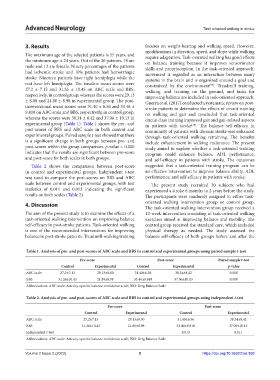
            27.2 ± 7.13 and 31.26 ± 10.43 on ABC scale and BBS,   walking, and training on the ground, and tasks for
            respectively, in control group, whereas the scores were 29.13   improving balance are included in task-oriented approach.
            ± 8.00 and 21.80 ± 8.98 in experimental group. The post-  Guerra et al. (2017) conducted a systematic review on post-
            interventional mean scores were 31.40 ± 6.56 and 33.46 ±   stroke patients to determine the effects of circuit training
            9.818 on ABC scale and BBS, respectively, in control group,   on  walking  and  gait  and  concluded  that  task-oriented
            whereas the scores were 38.34 ± 8.42 and 37.06 ± 10.13 in   circuit class training improved gait and gait-related aspects
            experimental group (Table 1). Table 1 shows the pre- and   in patients with stroke . The balance self-efficacy in
                                                                                   [38]
            post-scores of BBS and ABC scale in both control and   community of patients with chronic stroke was enhanced
            experimental groups. Paired sample t-test showed that there   through task-oriented walking retraining. The benefits
            is  a  significant  change  in  both  groups  between  pre-  and   include enhancement in walking endurance. The present
            post-scores within the group comparison. p-value = 0.000   study aimed to explore whether a task-oriented training
            indicates that the results are significant between pre-score   program  could  enhance  balance,  ADL  performance,
            and post-score for both scales in both groups.     and  self-efficacy  in  patients  with  stroke.  The  outcomes
              Table 2 shows the comparison between post-score   suggested that a task-oriented training program can be
            in control and  experimental groups. Independent  t-test   an effective intervention to improve balance ability, ADL
            was used to compare the post-scores on BBS and ABC   performance, and self-efficacy in patients with stroke.
            scale between control and experimental groups, with test   The present study recruited 30 subjects who had
            statistics of 0.011 and 0.013 indicating the significant   experienced a stroke 6 months to 2 years before the study.
            results on both scales (Table 2).                  The participants were randomly assigned to either task-

            4. Discussion                                      oriented walking intervention group or control group.
                                                               The task-oriented walking intervention group received a
            The aim of the present study is to examine the effects of a   12-week intervention consisting of task-oriented walking
            task-oriented walking intervention on improving balance   exercises aimed at improving balance and mobility. The
            self-efficacy in post-stroke patients. Task-oriented walking   control group received the standard care, which included
            is one of the recommended interventions for improving   physical therapy as needed. The study assessed the
            balance in post-stroke patients. Treadmill-walking training   balance self-efficacy of both groups before and after the


            Table 1. Analysis of pre‑ and post‑scores of ABC scale and BBS in control and experimental groups using paired sample t‑test
                                   Pre‑score                        Post‑score                Paired sample t‑test
                           Control       Experimental      Control         Experimental           p‑value
            ABC scale      27.2±7.13      29.13±8.00      31.40±6.56        38.34±8.42             0.000
            BBS           31.26±10.43     21.80±8.98      33.46±9.818      37.06±10.13             0.000
            Abbreviations: ABC scale: Activity-specific balance confidence scale; BBS: Berg Balance Scale

            Table 2. Analysis of pre‑ and post‑scores of ABC scale and BBS in control and experimental groups using independent t‑test

                                               Pre‑score                                Post‑score
                                     Control          Experimental           Control              Experimental
            ABC scale                27.2±7.13         29.13±8.00            31.40±6.56            38.34±8.42
            BBS                     31.26±10.43        21.80±8.98           33.46±9.818           37.06±10.13
            Independent t-test                                                0.013                  0.011
            Abbreviations: ABC scale: Activity-specific balance confidence scale; BBS: Berg Balance Scale


            Volume 2 Issue 2 (2023)                         5                          https://doi.org/10.36922/an.388

