


Page 77 - AN-2-4
P. 77
Advanced Neurology                                                    Sexual behavior and multiple sclerosis


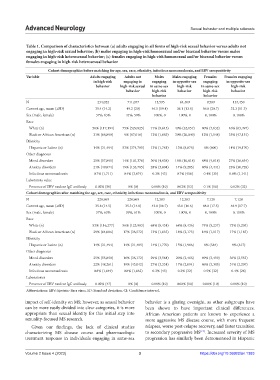
            Table 1. Comparison of characteristics between (a) adults engaging in all forms of high‑risk sexual behavior versus adults not
            engaging in high‑risk sexual behavior; (b) males engaging in high‑risk homosexual and/or bisexual behavior versus males
            engaging in high‑risk heterosexual behavior; (c) females engaging in high‑risk homosexual and/or bisexual behavior versus
            females engaging in high‑risk heterosexual behavior
                      Cohort demographics before matching for age, sex, race, ethnicity, infectious mononucleosis, and EBV seropositivity
            Variable                   Adults engaging   Adults not   Males   Males engaging   Females   Females engaging
                                         in high‑risk   engaging in   engaging   in opposite‑sex   engaging   in opposite‑sex
                                          behavior  high‑risk sexual   in same‑sex   high‑risk   in same‑sex   high‑risk
                                                       behavior   high‑risk   behavior  high‑risk   behavior
                                                                  behavior              behavior
            N                             234,022      711,077     13,595     64,409     9,589      137,450
            Current age, mean (±SD)       35.4 (14.2)  49.2 (20)  46.5 (19.4)  36.1 (13.6)  56.8 (20.7)  32.3 (11.3)
            Sex (male, female)            37%, 63%     41%, 59%   100%, 0    100%, 0    0, 100%     0, 100%
            Race
             White (n)                  50% (117,194)  75% (529,825)  71% (9,645)  49% (32,157)  80% (7,632)  46% (63,497)
             Black or African American (n)  31% (66,890)  9% (67,016)  12% (1,663)  30% (20,040)  12% (1,148)  35% (47,151)
            Ethnicity
             Hispanic or Latino (n)      14% (31,494)  53% (374,785)  13% (1,781)  13% (8,876)  6% (600)  14% (19,170)
            Other diagnoses
             Mood disorders              25% (57,895)  14% (101,370)  30% (4,038)  16% (10,818)  48% (4,618)  27% (36,654)
             Anxiety disorders           21% (49,874)  19% (133,785)  28% (3,804)  14% (9,285)  46% (4,441)  23% (30,728)
             Infectious mononucleosis    0.7% (1,711)  0.4% (3,074)  0.3% (43)  0.7% (456)  0.4% (35)  0.8% (1,141)
            Laboratory value
             Presence of EBV nuclear IgG antibody  0.02% (50)  0% (0)  0.08% (10)  0.02% (13)  0.1% (10)  0.02% (32)
            Cohort demographics after matching for age, sex, race, ethnicity, infectious mononucleosis, and EBV seropositivity
            N                             220,969      220,969     12,383     12,383     7,128       7,128
            Current age, mean (±SD)       35.8 (14.5)  35.3 (14.8)  43.0 (16.7)  43.0 (16.6)  48.8 (17.5)  48.9 (17.7)
            Sex (male, female)            37%, 63%     39%, 61%   100%, 0    100%, 0    0, 100%     0, 100%
            Race
             White (n)                  53% (116,277)  56% (123,983)  68% (8,434)  68% (8,436)  74% (5,237)  73% (5,203)
             Black or African American (n)  29% (64,086)  17% (36,572)  13% (1,633)  18% (2,173)  16% (1,117)  17% (1,183)
            Ethnicity
             Hispanic or Latino (n)      14% (31,494)  14% (31,485)  14% (1,770)  15% (1,906)  8% (584)  9% (617)
            Other diagnoses
             Mood disorders              25% (55,850)  16% (36,172)  29% (3,584)  20% (2,466)  49% (3,459)  36% (2,553)
             Anxiety disorders           22% (48,261)  19% (43,042)  27% (3,334)  17% (2,094)  46% (3,305)  31% (2,207)
             Infectious mononucleosis    0.8% (1,649)  0.8% (1,662)  0.3% (43)  0.3% (32)  0.5% (32)  0.4% (28)
            Laboratories
             Presence of EBV nuclear IgG antibody  0.02% (47)  0% (0)  0.08% (10)  0.08% (10)  0.08% (10)  0.08% (10)
            Abbreviations: EBV: Epstein–Barr virus, SD: Standard deviation, CI: Confidence interval.

            impact of self-identity on MS; however, as sexual behavior   behavior is a glaring oversight, as other subgroups have
            can be more easily divided into clear categories, it is more   been shown to have important clinical differences.
            appropriate than sexual identity for this initial step into   African American patients are known to experience a
            sexuality-focused MS research.                     more aggressive MS disease course, with more frequent
              Given our findings, the lack of clinical studies   relapses, worse post-relapse recovery, and faster transition
                                                                                      [12]
            characterizing MS disease course and pharmacologic   to secondary progressive MS . Increased severity of MS
            treatment response in individuals engaging in same-sex   progression has similarly been demonstrated in Hispanic

            Volume 2 Issue 4 (2023)                         3                         https://doi.org/10.36922/an.1383

