


Page 82 - AN-2-4
P. 82
Advanced Neurologyurology
            Advanced Ne                                                        NPRL2 as possible actor in reflex seizures


            classified based on  the  nature of the  triggering  stimuli:   contralateral hemisphere. These clinical manifestations
            sensory, motor, or cognitive; simple or complex. However,   included cyanosis, hypotonia, and impaired awareness,
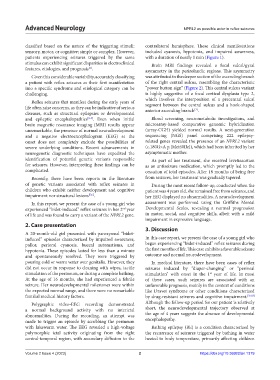
            patients experiencing  seizures  triggered by the  same   with a duration of nearly 1 min (Figure 1).
            stimulus can exhibit significant disparities in electroclinical   Brain MRI findings revealed a focal sulcal/gyral
            features, etiologies, and prognosis .              asymmetry in the perirolandic regions. This asymmetry
                                       [1]
              Given this considerable variability, accurately classifying   was attributed to the deeper section of the ascending branch
            a patient with reflex seizures as their first manifestation   of the right central sulcus, resembling the characteristic
            into a specific syndrome and etiological category can be   “power button sign” (Figure 2). This central sulcus variant
            challenging.                                       is highly suggestive of a focal cortical dysplasia type  2,
                                                               which involves the interposition of a precentral sulcal
              Reflex seizures that manifest during the early years of
            life often raise concerns, as they can be indicative of serious   segment between the central sulcus and a hook-shaped
                                                               anterior ascending branch .
                                                                                    [7]
            diseases, such as structural epilepsies or developmental
            and epileptic encephalopathies [2-4] . Even  when initial   Blood screening, neurometabolic investigations, and
            brain magnetic resonance imaging (MRI) results appear   microarray-based  comparative  genomic  hybridization
            unremarkable, the presence of normal neurodevelopment   (array-CGH) yielded normal results. A  next-generation
            and a negative electroencephalogram (EEG) at the   sequencing (NGS) panel comprising 222 epilepsy-
            onset  does  not  completely  exclude  the  possibilities  of   related genes revealed the presence of an NPRL2 variant
            severe underlying conditions. Recent advancements in   (c.180G>A p.[Met60Ile]), which had been inherited by her
            neurogenetic diagnostic techniques have expedited the   asymptomatic mother.
            identification of potential genetic variants responsible   As part of her treatment, she received levetiracetam
            for seizures. However, interpreting these findings can be   as an antiseizure medication, which promptly led to the
            complicated.                                       cessation of ictal episodes. After 18 months of being free

              Recently, there have been reports in the literature   from seizures, her treatment was gradually tapered.
            of genetic variants associated with reflex seizures in   During the most recent follow-up, conducted when the
            children who exhibit neither development and cognitive   patient was 4 years old, she remained free from seizures, and
            impairment nor structural lesions [5,6] .          her EEG displayed no abnormalities. A neurodevelopment
              In this report, we present the case of a young girl who   assessment was performed using the Griffiths Mental
            experienced “bidet-induced” reflex seizures in her 2  year   Developmental  Scales,  revealing  a  normal  progression
                                                     nd
            of life and was found to carry a variant of the NPRL2 gene.  in motor, social, and cognitive skills, albeit with a mild
                                                               impairment in expressive language.
            2. Case presentation
                                                               3. Discussion
            A 20-month-old girl presented with paroxysmal “bidet-
            induced” episodes characterized by impaired awareness,   In this case report, we present the case of a young girl who
            pallor, perioral cyanosis, buccal automatisms, and   began experiencing “bidet-induced” reflex seizures during
            hypotonia. These episodes lasted for less than a minute   the first months of life. This case exhibits a favorable seizure
            and spontaneously resolved. They were triggered by   outcome and normal neurodevelopment.
            pouring cold or warm water over genitalia. However, they   In medical literature, there have been cases of reflex
            did not occur in response to cleaning with wipes, tactile   seizures induced by “diaper-changing” or “perineal
            stimulation of the perineum, or during a complete bathing.   stimulation” with onset in the 1   year of life. In most
                                                                                          st
            At the age of 16  months, she had experienced a febrile   of these cases, such seizures are associated with an
            seizure. Her neurodevelopmental milestones were within   unfavorable prognosis, mainly in the context of conditions
            the expected normal range, and there were no remarkable   like Dravet syndrome or other conditions characterized
            familial medical history factors.                  by drug-resistant seizures and cognitive impairment. [3,4,8]
              Polygraphic video-EEG recording demonstrated     Although the follow-up period for our patient is relatively
            a normal background activity  with  no  interictal   short,  the  neurodevelopmental  trajectory  observed  at
            abnormalities. During the recording, an attempt was   the age of 4 years suggests the absence of developmental
            made to trigger an episode by scrubbing the perineum   encephalopathy.
            with lukewarm water. The EEG revealed a high-voltage   Bathing epilepsy (BE) is a condition characterized by
            polymorphic ictal activity originating from the right   the recurrence of seizures triggered by bathing in water
            central-temporal region, with secondary diffusion to the   heated to body temperature, primarily affecting children


            Volume 2 Issue 4 (2023)                         2                         https://doi.org/10.36922/an.1379

