


Page 87 - AN-2-4
P. 87
Advanced Neurologyurology
            Advanced Ne                                                         Narcolepsy-multiple sclerosis coexistence


            disorders and offering insights, for clinicians, into treating   and NREM3 stages were found to be reduced, accounting
            this rare comorbidity.                             for 35.3% and 9.6%, respectively. It is noteworthy that
                                                               the orexin A level in the patient’s cerebrospinal fluid
            2. Case presentation                               was significantly reduced, measuring only at 8.49 pg/mL

            In April 2023, a 21-year-old male who experienced a   (normal range >200 pg/mL). Furthermore, testing of genes
            notable increase in sleep duration over the past 5 years,   associated with narcolepsy susceptibility revealed that the
            accompanied by the urge to fall asleep, nightmares, and   patient is homozygous for  HLA-DQB1*06:02 and  TCRA
            sleep paralysis during waking hours, reached out to seek   rs1154155, and heterozygous for  P2RY11 rs2305795.
            medical consultation in our clinic. These symptoms were   These genetic markers, combined with the diminished
            unpredictable and seemingly not correlated with changes   orexin A levels, present a comprehensive overview of the
            in the body position or other discernible triggers. He has   patient’s predisposition. Upon integrating these findings,
            no history of chronic diseases or relevant familial inherited   the patient was provisionally diagnosed with narcolepsy
            diseases. A  series of evaluations regarding his condition   type 1 according to the International Classification of Sleep
                                                                         rd
                                                                                              [3]
            were conducted.                                    Disorders, 3  edition (ICSD-3) criteria .
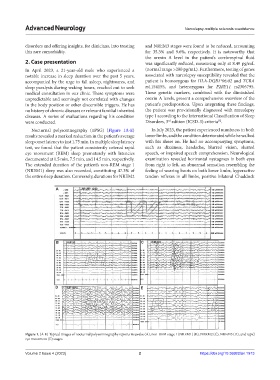
              Nocturnal polysomnography (nPSG) (Figure  1A-E)    In July 2023, the patient experienced numbness in both
            results revealed a marked reduction in the patient’s average   lower limbs, and the condition deteriorated while he walked
            sleep onset latency to just 1.75 min. In multiple sleep latency   with his shoes on. He had no accompanying symptoms,
            test, we found that the patient consistently entered rapid   such  as dizziness, headache, blurred  vision,  slurred
            eye movement (REM) sleep prematurely with latencies   speech, or impaired speech comprehension. Neurological
            documented at 1.5 min, 7.5 min, and 14.5 min, respectively.   examination revealed horizontal nystagmus in both eyes
            The extended duration of the patient’s non-REM stage 1   from right to left, an abnormal sensation resembling the
            (NREM1) sleep was also recorded, constituting 47.3% of   feeling of wearing boots on both lower limbs, hyperactive
            the entire sleep duration. Conversely, durations for NREM2   tendon  reflexes  in  all  limbs,  positive  bilateral  Chaddock


                         A


                         B                                   C


                         D                                   E


            Figure 1. (A-E) Typical images of nocturnal polysomnography reports in awake (A), non-REM stage 1 (NREM1) (B), NREM2 (C), NREM3 (D), and rapid
            eye movement (E) stages.


            Volume 2 Issue 4 (2023)                         2                         https://doi.org/10.36922/an.1913

