


Page 88 - AN-2-4
P. 88
Advanced Neurology                                                  Narcolepsy-multiple sclerosis coexistence


            and Hoffman signs, a positive Babinski sign on the right, a   At the beginning, the patient received a course of
            positive Romberg sign, and an ataxic gait.         shock therapy consisting of 1.0  g methylprednisolone
              As revealed by brain magnetic resonance imaging   administered daily for a consecutive 3 days. The dosage
            (MRI), multiple lesions with high T2 or FLAIR signals   was then gradually tapered to 500  mg, 250  mg,  and
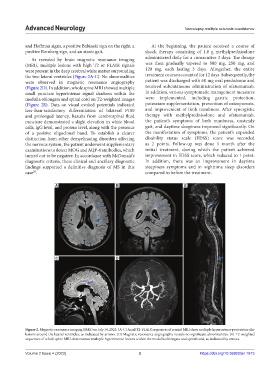
            were present in the deep cerebral white matter surrounding   120  mg, each lasting 3  days. Altogether, the entire
            the two lateral ventricles (Figure 2A-C). No abnormalities   treatment course accounted for 12 days. Subsequently, the
            were observed in magnetic resonance angiography    patient was discharged with 60 mg oral prednisone and
            (Figure 2D). In addition, whole spine MRI showed multiple   received subcutaneous  administration of ofatumumab.
            small punctate hyperintense signal shadows within the   In addition, various symptomatic management measures
            medulla oblongata and spinal cord on T2-weighted images   were implemented, including gastric protection,
            (Figure  2E). Data on visual evoked potentials indicated   potassium supplementation, prevention of osteoporosis,
            less-than-satisfactory differentiation of bilateral P100   and improvement of limb numbness. After synergistic
            and prolonged latency. Results from cerebrospinal fluid   therapy with methylprednisolone and ofatumumab,
            puncture demonstrated a slight elevation in white blood   the patient’s symptoms of limb numbness, unsteady
            cells, lgG level, and protein level, along with the presence   gait, and daytime sleepiness improved significantly. On
            of a positive oligoclonal band. To establish a clearer   the manifestation of symptoms, the patient’s expanded
            distinction  from  other  demyelinating  disorders  affecting   disability status scale (EDSS) score was recorded
            the nervous system, the patient underwent supplementary   as 2 points. Follow-up was done 1  month after the
            examinations to detect MOG and AQP-4 antibodies, which   initial treatment, during which the patient achieved
            turned out to be negative. In accordance with McDonald’s   improvement in EDSS score, which reduced to 1 point.
            diagnostic criteria, these clinical and ancillary diagnostic   In  addition,  there  was  an  improvement  in  daytime
            findings supported a definitive diagnosis of MS in this   sleepiness symptoms and in nighttime sleep disorders
            case .                                             compared to before the treatment.
               [4]
                         A                        B                            E


                         C                        D


            Figure 2. Magnetic resonance imaging (MRI) on July 14, 2023. (A-C) Axial T2-FLAIR sequences of cranial MRI show multiple hyperintense periventricular
            lesions around the lateral ventricles, as indicated by arrows. (D) Magnetic resonance angiography reveals no significant abnormalities. (E) T2-weighted
            sequences of whole spine MRI demonstrate multiple hyperintense lesions within the medulla oblongata and spinal cord, as indicated by arrows.


            Volume 2 Issue 4 (2023)                         3                         https://doi.org/10.36922/an.1913

