


Page 9 - AN-3-3
P. 9
Advanced Neurology                                           Alzheimer’s and Parkinson’s disease rodent models


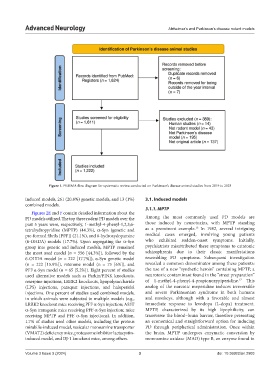
                      Figure 1. PRISMA flow diagram for systematic review conducted on Parkinson’s disease animal studies from 2019 to 2023

            induced models, 261 (20.8%) genetic models, and 13 (1%)   3.1. Induced models
            combined models.
                                                               3.1.1. MPTP
              Figures 2E and F contain detailed information about the
            PD models utilized. The top three rodent PD models over the   Among the most commonly used PD models are
            past 5 years were, respectively, 1-methyl-4-phenyl-1,2,3,6-  those induced by neurotoxins, with MPTP standing
                                                                                    16
            tetrahydropyridine (MPTP) (44.3%),  α-Syn (genetic and   as a prominent example.  In 1982, several intriguing
            pre-formed fibrils [PFF]) (21.1%), and 6-hydroxydopamine   medical  cases  emerged,  involving  young  patients
            (6-OHDA) models (17.7%). Upon segregating the  α-Syn   who exhibited sudden-onset symptoms. Initially,
            group into genetic and induced models, MPTP remained   psychiatrists misattributed these symptoms to catatonic
            the most used model (n  = 556 [44.3%]), followed by the   schizophrenia due to their classic manifestations
            6-OHDA model (n = 222 [17.7%]), α-Syn genetic model   resembling PD  symptoms. Subsequent investigation
            (n = 222 [15.9%]), rotenone model (n = 75 [6%]), and   revealed a common denominator among these patients:
            PFF α-Syn model (n = 65 [5.2%]). Eight percent of studies   the use of a new “synthetic heroin” containing MPTP, a
            used alternative models such as Parkin/PINK knockouts,   neurotoxic contaminant found in the “street preparation”
                                                                                                       17
            reserpine injections, LRRK2 knockouts, lipopolysaccharide   of 1-methyl-4-phenyl-4-propionoxypiperidine.  This
            (LPS) injections, paraquat injections, and haloperidol   analog of the narcotic meperidine induces irreversible
            injections. One percent of studies used combined models,   and severe Parkinsonian syndrome in both humans
            in which animals were subjected to multiple models (e.g.,   and monkeys, although with a favorable and almost
            LRRK2 knockout mice receiving PFF α-Syn injection; A53T   immediate response to levodopa (L-dopa) treatment.
            α-Syn transgenic mice receiving PFF α-Syn injection; mice   MPTP, characterized by its high lipophilicity, can
            receiving MPTP and PFF  α-Syn injections). In addition,   transverse the blood–brain barrier, therefore presenting
            1.7% of studies used other models, including the proteus   an economical and straightforward option for inducing
            mirabilis-induced model, vesicular monoamine transporter   PD  through  peripherical  administration.  Once  within
            (VMAT2) deficiency mice, proteasome inhibitor lactacystin-  the brain, MPTP undergoes enzymatic conversion by
            induced model, and DJ-1 knockout mice, among others.  monoamine oxidase (MAO) type B, an enzyme found in


            Volume 3 Issue 3 (2024)                         3                                doi: 10.36922/an.2903

