


Page 14 - AN-3-3
P. 14
Advanced Neurology                                           Alzheimer’s and Parkinson’s disease rodent models


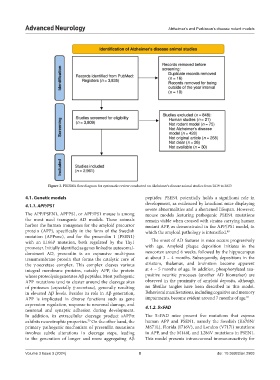
                      Figure 3. PRISMA flow diagram for systematic review conducted on Alzheimer’s disease animal studies from 2019 to 2023

            4.1. Genetic models                                peptides. PSEN1 potentially holds a significant role in
            4.1.1. APP/PS1                                     development, as evidenced by knockout mice displaying
                                                               severe abnormalities and a shortened lifespan. However,
            The APP/PSEN1, APPPS1, or APP/PS1 mouse is among   mouse models featuring pathogenic PSEN1 mutations
            the most used transgenic AD models. These animals   remain viable when crossed with strains carrying human
            harbor the human transgenes for the amyloid precursor   mutant APP, as demonstrated in the APP/PS1 model, in
            protein (APP), specifically in the form of the Swedish   which the amyloid pathology is intensified. 80
            mutation  (APPswe),  and  for  the  presenilin  1  (PSEN1)
            with an L166P mutation, both regulated by the Thy1   The onset of AD features in mice occurs progressively
            promoter. Initially identified as genes linked to autosomal-  with age. Amyloid plaque deposition initiates in the
            dominant AD,  presenilin  is  an expansive  multi-pass   neocortex around 6 weeks, followed by the hippocampus
            transmembrane protein that forms the catalytic core of   at about 3 – 4  months. Subsequently, depositions in the
            the  γ-secretase complex. This complex cleaves various   striatum, thalamus, and brainstem become apparent
            integral membrane proteins, notably APP, the protein   at 4 – 5 months of age. In addition, phosphorylated tau-
            whose proteolysis generates Aβ peptides. Most pathogenic   positive  neuritic processes (another AD biomarker) are
            APP mutations tend to cluster around the cleavage sites   observed in the proximity of amyloid deposits, although
            of proteases (especially  γ-secretase), generally resulting   no  fibrillar tangles have  been described in  this  model.
            in elevated Aβ levels. Besides its role in Aβ generation,   Behavioral manifestations, including cognitive and memory
            APP  is  implicated  in  diverse  functions  such  as  gene   impairments, become evident around 7 months of age. 81
            expression regulation, response to neuronal damage, and   4.1.2. 5×FAD
            neuronal and synaptic adhesion during development.
            In addition, its extracellular cleavage product sAPPα   The  5×FAD  mice  present  five  mutations  that  express
            exhibits neurotrophic properties.  On the other hand, the   human  APP  and  PSEN1,  namely  the  Swedish  (K670N/
                                      79
            primary pathogenic mechanism of presenilin mutations   M671L), Florida (I716V), and London (V717I) mutations
            involves subtle alterations in cleavage steps, leading   in APP, and the M146L and L286V mutations in PSEN1.
            to the generation of longer and more aggregating Aβ   This model presents intraneuronal immunoreactivity for


            Volume 3 Issue 3 (2024)                         8                                doi: 10.36922/an.2903

