


Page 108 - AN-4-4
P. 108
Advanced Neurology                                                          Incidental PFBC: Case report


            of individuals with autosomal dominant PFBC remain
            asymptomatic throughout their lifetime. 2
              To date, mutations in six genes have been found to
            be associated with PFBC; four are autosomal dominant
            (solute  carrier  family  20  member  2,  xenotropic  and
            polytropic retrovirus receptor 1, platelet-derived growth
            factor  beta  [PDGFB],  and  platelet-derived  growth factor
            receptor beta [PDGFRB]) and two are autosomal recessive
            (myogenesis regulating glycosidase and junctional-
            adhesion molecule-2). 2
              Herein, we report an asymptomatic case of PFBC
            discovered incidentally on a computed tomography (CT)
            scan of the brain in a middle-aged male being evaluated
            for sinus complaints. Comprehensive family history and
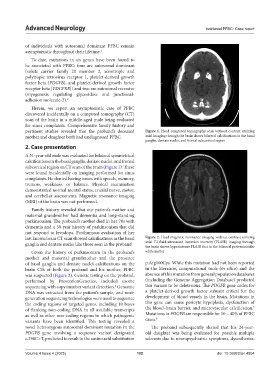
            pertinent studies revealed that the proband’s deceased   Figure  1.  Head computed tomography scan without contrast utilizing
            mother and daughter both had undiagnosed PFBC.     axial imaging through the brain shows bilateral calcifications in the basal
                                                               ganglia, dentate nuclei, and frontal subcortical region
            2. Case presentation
            A 51-year-old male was evaluated for bilateral symmetrical
            calcifications in the basal ganglia, dentate nuclei, and frontal
            subcortical region on CT scan of the brain (Figure 1). These
            were found incidentally on imaging performed for sinus
            complaints. He denied having issues with speech, memory,
            tremors, weakness, or balance. Physical examination
            demonstrated normal mental status, cranial nerve, motor,
            and cerebellar assessments. Magnetic resonance imaging
            (MRI) of the brain was not performed.
              Family history revealed that our patient’s mother and
            maternal grandmother had dementia and long-standing
            parkinsonism. The proband’s mother died in her 70s with
            dementia and a 30-year history of parkinsonism that did
            not respond to levodopa. Posthumous evaluation of her
            last known brain CT scan showed calcifications in the basal   Figure 2. Head magnetic resonance imaging without contrast utilizing
            ganglia and dentate nuclei like those seen in the proband.  axial T2 fluid-attenuated inversion recovery (FLAIR) imaging through
                                                               the brain shows hyperintense FLAIR foci in the bilateral periventricular
              Given the history of parkinsonism in the proband’s   white matter
            mother and maternal grandmother and the presence
            of basal ganglia and dentate nuclei calcifications on the   p.Arg100Cys. While this mutation had not been reported
            brain CTs of both the proband and his mother, PFBC   in the literature, computational tools (in silico) and the
            was suspected (Figure 2). Genetic testing on the proband,   absence of this mutation from general population databases
            performed by PreventionGenetics,  included exome   (including the Genome Aggregation Database) predicted
            sequencing with copy number variant detection.  Genomic   this variant to be deleterious. The PDGFB gene codes for
                                                  4
            DNA was extracted from the patient’s sample, and next-  a platelet-derived growth factor subunit critical for the
            generation sequencing technologies were used to sequence   development of blood vessels in the brain. Mutations in
            the coding regions of targeted genes, including 10 bases   this gene can cause pericyte hypoplasia, dysfunction of
                                                                                                             5
            of flanking non-coding DNA in all available transcripts   the blood–brain barrier, and microvascular calcification.
            as well as other non-coding regions in which pathogenic   Mutations in PDGFB are responsible for 10 – 40% of PFBC
                                                                   6
            variants have been identified. This testing revealed a   cases.
            novel heterozygous autosomal dominant mutation in the   The proband subsequently shared that his 24-year-
            PDGFB gene involving a sequence variant designated   old daughter was being evaluated for possible multiple
            c.298C>T, predicted to result in the amino acid substitution   sclerosis due to neuropsychiatric symptoms, dysesthesias,


            Volume 4 Issue 4 (2025)                        102                               doi: 10.36922/an.4854

