


Page 113 - AN-4-4
P. 113
Advanced Neurology                                                         CAA-related inflammatory case


            by slow reaction for 2  months, with aggravation and   department of our hospital. While waiting for treatment,
            abnormal behavior for 1 day.” Two months before seeking   the patient developed a disturbance of consciousness
            medical consultation, the patient had developed unsteady   accompanied by generalized tonic-clonic seizures. He was
            walking and a slow reaction without apparent reasons. He   admitted to our department for further treatment.
            visited the emergency department of our hospital, where a   The patient had a history of hypertension and had
            cranial computed tomography (CT) scan was conducted,   undergone abdominal aortic aneurysm stenting and renal
            showing multiple white matter lesions in the brain. When   artery stenting. At admission, his body temperature was
            he was admitted to the hospital, biochemical tests indicated   36.5°C, pulse rate was 72 beats/min, and blood pressure
            that creatinine was 158  μmol/L and serum potassium
            was 2.97 mmol/L. The results of blood routine, hepatitis   was 166/78 mmHg. The patient was conscious but listless
            B, treponema pallidum, human immunodeficiency      and was wheeled into the ward on a stretcher. At this point,
            virus, and immune tests were normal. Further cranial   he had a slow reaction, poor memory of recent events, and
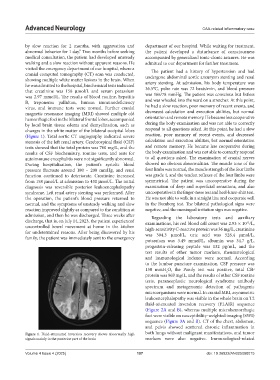
            magnetic resonance imaging (MRI) showed multiple old   decreased calculation and execution abilities, but normal
            hemorrhagic foci in the bilateral frontal lobes, accompanied   orientation and remote memory. He became less cooperative
            by local brain tissue edema and demyelination, such as   during the body examination and was not able to correctly
            changes in the white matter of the bilateral occipital lobes   respond to all questions asked. At this point, he had a slow
            (Figure 1). Total aortic CT angiography indicated severe   reaction,  poor  memory  of  recent  events,  and  decreased
            stenosis of the left renal artery. Cerebrospinal fluid (CSF)   calculation and execution abilities, but normal orientation
            tests showed that the total protein was 760 mg/L, and the   and remote memory. He became less cooperative during
            results  of  CSF biochemistry, routine  tests,  and  tests  for   the body examination and was not able to correctly respond
            autoimmune encephalitis were not significantly abnormal.   to all questions asked. The examination of cranial nerves
            During  hospitalization,  the  patient’s  systolic  blood   showed no obvious abnormalities. The muscle tone of the
            pressure fluctuate around 180 – 200  mmHg, and renal   four limbs was normal, the muscle strength of the four limbs
            function continued to deteriorate. Creatinine increased   was grade 4, and the tendon reflexes of the four limbs were
            from 158 μmol/L at admission to 430 μmol/L. The initial   symmetrical. The patient was uncooperative during the
            diagnosis was reversible posterior leukoencephalopathy   examination of deep and superficial sensations, and also
            syndrome. Left renal artery stenting was performed. After   uncooperative in the finger-nose test and heel-knee-shin test.
            the operation, the patient’s blood pressure returned to   He was not able to walk in a straight line and cooperate well
            normal, and the symptoms of unsteady walking and slow   in the Romberg test. The bilateral pathological signs were
            reaction improved slightly as compared to the condition at   negative, and the meningeal irritation sign was negative.
            admission, and then he was discharged. Three weeks after   Regarding the laboratory tests and auxiliary
            discharge, that is, on July 14, 2023, the patient experienced   examinations, his red blood cell count was 2.93 × 10 /L,
                                                                                                          12
            uncontrolled bowel movement at home in the kitchen   high-sensitivity C-reactive protein was 36 mg/L, creatinine
            for undetermined reasons. After being discovered by his   was 304.3  μmol/L, uric acid was 528.4  μmol/L,
            family, the patient was immediately sent to the emergency
                                                               potassium was 3.49 mmol/L, albumin was 34.7  g/L,
                                                               progastrin-releasing peptide was 132  pg/mL, and the
                                                               test  results of other tumor  markers,  rheumatological
                                                               and immunological indexes were normal. According
                                                               to  the  lumbar  puncture  examination,  CSF  pressure  was
                                                               150 mmH O, the Pandy test was positive, total CSF
                                                                        2
                                                               protein was 969 mg/L, and the results of other CSF routine
                                                               tests, paraneoplastic neurological syndrome antibody
                                                               spectrum and metagenomic detection of pathogenic
                                                               microorganisms were normal. In cranial MRI, asymmetric
                                                               leukoencephalopathy was visible in the whole brain on T2
                                                               fluid-attenuated inversion recovery (FLAIR) sequence
                                                               (Figure 2A and B), whereas multiple microhemorrhagic
                                                               foci were visible on susceptibility-weighted imaging (SWI)
                                                               sequence (Figure 3A and B). CT of the chest, abdomen,
                                                               and  pelvis showed scattered chronic  inflammation  in
            Figure  1. Fluid-attenuated inversion recovery shows abnormally high   both lungs without malignant manifestations, and tumor
            signals mainly in the posterior part of the brain  markers were also negative. Immunological-related


            Volume 4 Issue 4 (2025)                        107                           doi: 10.36922/AN025080015

