


Page 109 - AN-4-4
P. 109
Advanced Neurology                                                          Incidental PFBC: Case report


            tremors, and MRI of the brain showing extensive non-  pathologic etiologies must be considered (Table  1). The
            enhancing hyperintensities throughout the white matter of   only physiologic or pathologic cause of brain calcifications
            the frontal region (concerning for demyelinating disease)   that manifests in a symmetrical fashion in both the basal
                                                                                              1,8
            (Figure 2). Cerebrospinal fluid was negative for oligoclonal   ganglia and dentate nuclei is PFBC,  and mutational
            bands, making multiple sclerosis an unlikely diagnosis. No   analysis confirmed this diagnosis.
            other potential etiologies for the white matter changes were   Publications describing the various gene mutations
            identified. An eventual CT scan of her brain, performed   associated with PFBC and their phenotypes suggest that
            due to the recent PFBC diagnosis in the father, showed   subcortical white matter hyperintensities are not a common
            calcifications  in  the  basal  ganglia  (Figure  2).  Genetic   finding. However, there are rare reports of subcortical
            testing on the daughter revealed the same heterozygous   white matter changes in the brain in individuals with
            mutation (c.298C>T, p.Arg100Cys) in the  PDGFB gene   PFBC. PDGF proteins are highly expressed in white matter,
            (Figure  3).   All  neurologists  involved  in  her  care  agreed   justifying the impacts of PDGFB gene mutations on this
                     7
            that the white matter findings were related to the PFBC   part of the brain.  Four reports describe a handful of PFBC
                                                                            9
            diagnosis.                                         families with subcortical white matter hyperintensities. 10-13
                                                               All of the described subjects had a mutation in either the
            3. Discussion                                      PDGFB  or  the  PDGFRB  gene.  Similarly,  the  daughter
            The patient presented with bilateral symmetrical   of our proband, who was found to have a  PDGFB
            calcifications of the basal ganglia and dentate nuclei.   mutation,  had  non-enhancing  subcortical  white  matter
            History and physical examination did not demonstrate   hyperintensities in both frontal lobes. Therefore, while it
            signs or symptoms that might be expected with these CT   is possible that other PFBC-associated genes could lead to
            findings, such as parkinsonism, tremors, dystonia, chorea,   these lesions, none have been reported to date. The only
            ataxia, and/or cognitive/memory impairment.        PFBC-associated  gene  mutations  known  to  compromise
                                                               the blood–brain barrier are PDGFB and PDGFRB, which
              When  considering  the  differential  diagnosis  for
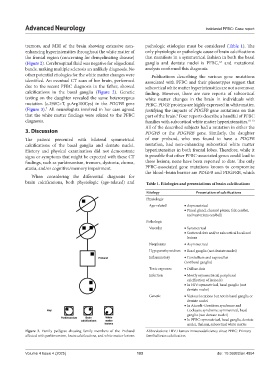
            brain calcifications, both physiologic (age-related) and   Table 1. Etiologies and presentations of brain calcifications
                                                               Etiology             Presentation of calcifications
                                                               Physiologic
                                                                Age-related    • Asymmetrical
                                                                               •  Pineal gland, choroid plexus, falx cerebri,
                                                                                 and tentorium cerebelli
                                                               Pathologic
                                                                Vascular       • Symmetrical
                                                                               •  Scattered dots and/or subcortical localized
                                                                                 lesions
                                                                Neoplasms      • Asymmetrical
                                                                Hypoparathyroidism  • Basal ganglia (not dentate nuclei)
                                                                Inflammatory   • Cerebellum and suprasellar
                                                                               (not basal ganglia)
                                                                Toxic exposure   • Diffuse dots
                                                                Infection      •  Mostly asymmetrical, peripheral
                                                                                 calcification of lesion(s)
                                                                               •  In HIV: symmetrical, basal ganglia (not
                                                                                 dentate nuclei)
                                                                Genetic        •  Various locations but not in basal ganglia or
                                                                                 dentate nuclei
                                                                               •  In Aicardi–Goutières syndrome and
                                                                                 Cockayne syndrome: symmetrical, basal
                                                                                 ganglia (not dentate nuclei)
                                                                               •  In PFBC: symmetrical, basal ganglia, dentate
                                                                                 nuclei, thalami, subcortical white matter
            Figure  3.  Family pedigree showing family members of the Proband   Abbreviations: HIV: Human immunodeficiency virus; PFBC: Primary
            affected with parkinsonism, brain calcifications, and white matter lesions  familial brain calcification.


            Volume 4 Issue 4 (2025)                        103                               doi: 10.36922/an.4854

