


Page 114 - AN-4-4
P. 114
Advanced Neurology                                                         CAA-related inflammatory case


             A                     B


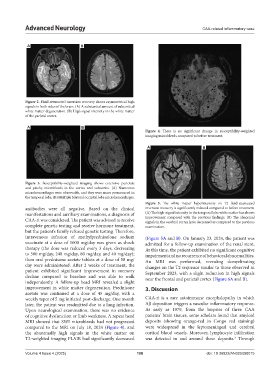
            Figure 2. Fluid-attenuated inversion recovery shows asymmetrical high
            signals in both sides of the brain. (A) A substantial amount of subcortical
            white matter degeneration. (B) High signal intensity in the white matter
            of the parietal cortex.

             A                      B
                                                               Figure  4. There is no significant change in susceptibility-weighted
                                                               imaging microbleeds compared to before treatment.

                                                                A                      B


            Figure  3. Susceptibility-weighted imaging shows extensive punctate
            and patchy microbleeds in the cortex and subcortex. (A) Numerous
            microhemorrhages were observable, and they were more pronounced in
            the temporal lobe. (B) Multiple bilateral occipital lobe microhemorrhages.
                                                               Figure  5. The white matter hyperintensity on  T2 fluid-attenuated
            antibodies were all negative. Based on the clinical   inversion recovery is significantly reduced compared to before treatment.
            manifestations and auxiliary examinations, a diagnosis of   (A) The high-signal intensity in the temporal lobe white matter has shown
                                                               improvement compared with the  previous  findings.  (B)  The  abnormal
            CAA-ri was considered. The patient was advised to receive   signals in the cerebral cortex have decreased as compared to the previous
            complete genetic testing and receive hormone treatment,   examination.
            but the patient’s family refused genetic testing. Therefore,
            intravenous infusion of methylprednisolone sodium   (Figure 5A and B). On January 23, 2024, the patient was
            succinate at a dose of 1000  mg/day was given as shock   admitted for a follow-up examination of the renal stent.
            therapy (the dose was reduced every 3 days, decreasing   At this time, the patient exhibited no significant cognitive
            to 500 mg/day, 240 mg/day, 80 mg/day, and 40 mg/day);   impairment and no recurrence of behavioral abnormalities.
            then oral prednisone acetate tablets at a dose of 50 mg/  An  MRI  was  performed,  revealing  demyelinating
            day were administered. After 2  weeks of treatment, the   changes on the T2 sequence similar to those observed in
            patient  exhibited  significant  improvement  in  memory   September 2023, with a slight reduction in high signals
            decline compared to baseline and was able to walk   near the frontal and parietal cortex (Figure 6A and B).
            independently. A  follow-up head MRI revealed a slight
            improvement  in  white  matter  degeneration.  Prednisone   3. Discussion
            acetate was continued at a dose of 45  mg/day, with a
            weekly taper of 5 mg initiated post-discharge. One month   CAA-ri is a rare autoimmune encephalopathy in which
            later, the patient was readmitted due to a lung infection.   Aβ deposition triggers a vascular inflammatory response.
            Upon  neurological examination,  there was no  evidence   As early as 1979, from the biopsies of three CAA
            of cognitive dysfunction or limb weakness. A repeat head   patients’ brain tissues, some scholars found that amyloid
            MRI  showed that SWI microbleeds had not progressed   deposits (showing orange-red in Congo red staining)
            compared to the MRI on July 18, 2024 (Figure  4), and   were widespread in the leptomeningeal and cerebral
            the abnormally high signals in the white matter on   cortical  blood  vessels.  Moreover,  lymphocyte  infiltration
            T2-weighted imaging FLAIR had significantly decreased   was  detected  in  and  around  these  deposits.   Through
                                                                                                     3

            Volume 4 Issue 4 (2025)                        108                           doi: 10.36922/AN025080015

