


Page 45 - AN-4-4
P. 45
Advanced Neurology                                                  Lipid metabolism and Parkinson’s disease


            PE/PS transport, impairing CL synthesis, and triggering   promotes α-Syn aggregation; 96,97  and GlcCer accumulation
            mitochondrial apoptosis.   GBA1 mutations (a major   triggers a “lysosomal damage–α-Syn aggregation–
                                 29
            PD  risk  factor)  reduce  GCase  activity,  causing  GlcCer   neuroinflammation” cycle.  Furthermore, SCFAs link gut
                                                                                    107
            accumulation in lysosomes. GlcCer inhibits the V-ATPase   dysbiosis to neuroinflammation through TLR4/NF-κB
            proton pump, raising lysosomal pH, inactivating LAL, and   activation, while LPC imbalance exacerbates inflammation
            impairing lipophagy while disrupting  α-Syn’s tetramer–  and α-Syn pathology through GPR35–ERK signaling.  In
                                                                                                         131
                                               26
            monomer balance to promote aggregation.  In addition,   addition, as discussed in Section 3.3.2, gangliosides GM1 and
            LPC activates the GPR35–ERK pathway, disrupting Golgi   GM3 play pivotal roles in PD pathogenesis, with GM1 acting
            structure and blocking GCase transport to lysosomes,   as a neuroprotective agent and GM3 promoting pathological
            exacerbating GlcCer accumulation. 131              progression. 116-118  Disruptions in their expression levels or
              Lipid metabolism  dysregulation involves multiple   metabolic equilibrium directly contribute to dopaminergic
            pathogenic pathways: FA imbalance (e.g., PUFA reduction and   neuron loss and abnormal  α-Syn aggregation, thereby
            SCFA-mediated inflammation), phospholipid remodeling   accelerating disease progression.
            (e.g., CL/PC/PE dysfunction), sphingolipid disruption (e.g.,   Despite these insights, key questions remain: the
            Cer/GlcCer accumulation), and cholesterol metabolite-  causal timeline of lipid abnormalities (whether initiator
            driven α-Syn aggregation. 59,144-146  These abnormalities form a   or consequence of PD) requires longitudinal validation,
            complex network: reduced PUFAs impair membrane fluidity   and cell-type specificity in lipid metabolism (e.g., neuronal
            and neuroprotection; CL deficiency disrupts mitochondrial   vs. glial differences) needs elucidation through single-
            respiration and  α-Syn stability; 88,145  PC/PE imbalance   cell approaches. Translational challenges, such as BBB


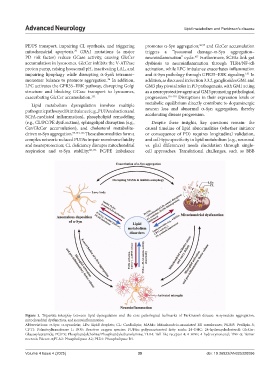
            Figure  1. Tripartite interplay between lipid dysregulation and the core pathological hallmarks of Parkinson’s disease:  α-synuclein aggregation,
            mitochondrial dysfunction, and neuroinflammation
            Abbreviations:  α-Syn:  α-synuclein; LDs: Lipid droplets; CL: Cardiolipin; MAMs: Mitochondria-associated ER membranes; PLIN5: Perilipin-5;
            CPT1: Palmitoyltransferase  1; ROS: Reactive oxygen species; PUFAs: polyunsaturated fatty acids; 24-OHC: 24-hydroxycholesterol; GlcCer:
            Glucosylceramide; PC/PE: Phosphatidylcholine/Phosphatidylethanolamine; TLR4: Toll-like receptor 4; 4-HNE: 4-hydroxynonenal; TNF-α: Tumor
            necrosis FActor-α;PLA2: Phospholipase A2; PLD1: Phospholipase D1.


            Volume 4 Issue 4 (2025)                         39                           doi: 10.36922/AN025320086

