


Page 34 - ARNM-2-1
P. 34
Advances in Radiotherapy
            & Nuclear Medicine                                                  99m Tc-DOX in multidrug resistance studies


            (FCS; Cultilab, Brazil) and antibiotics at 37°C in 5% CO    (Invitrogen, Brazil USA), 2 mM l-glutamine, 100 U/mL
                                                          2
            atmosphere. Cells were passaged twice a week.      penicillin, and 100 µg/mL, 1% sodium pyruvate, and 1%
                                                               nonessential amino acids (Sigma-Aldrich, US) for 48 h.
            2.5. Detection of Pgp expression                   After reaching confluency, the cells were collected with

            For Pgp detection, cells were washed using phosphate-  trypsin-EDTA (Invitrogen) and centrifuged at 1200 rpm
            buffered saline (PBS) containing 5% FCS and incubated   for 10  min. Cells (10   cells/mL) were suspended in
                                                                                  6
            at 4°C for 30 min with mouse anti-human P-glycoprotein   DMEM  without  serum.  This  cell  suspension  (100  µL,
            – FITC antibody (BD Pharmigen, USA) at a dilution of   10   cells per animal) was injected subcutaneously in
                                                                 5
            1:4 (v/v). Negative control cells were incubated at 4°C for   C57/Bl6 mice’s left paws, and tumor growth was
            30 min, without the antibody, in PBS containing 5% FCS.   monitored for 15 days.
            Following this, cells were washed and resuspended in PBS
            containing 5% FCS. At least 10,000 events were recorded   2.9. Statistical analysis
            within the gated region of the flow cytometer FACSCan   Student’s t-test was employed to analyze the significance
            (Beckton & Dickinson, USA).                        of the difference in Pgp expression and cell viability.
                                                               Differences were considered statistically significant when
            2.6. Assessment of Pgp activity
                                                               P < 0.05.
            For the assessment of Pgp activity, cells were washed using
            a medium containing 10% FCS and incubated at 37°C for   3. Results
            30 min with Rhodamine 123 (Rho; Sigma-Aldrich, USA), a   3.1. Radiolabeling and stability
            Pgp’s fluorescent substrate, at a concentration of 200 ng/mL,
            in  the  presence  or  absence  of  5  µM  verapamil  (Sigma-  The labeling efficiency was maintained at around 90%
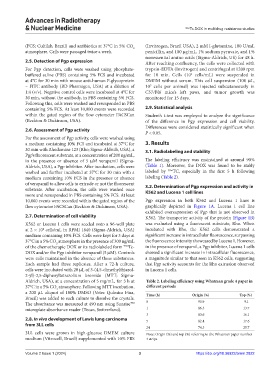
            Aldrich, USA), a Pgp inhibitor. After incubation, cells were   (Table  1). Moreover, the DOX was found to be stably
            washed and further incubated at 37°C for 30 min with a   labeled by   99m TC,  especially  in the  first  5  h following
            medium containing 10% FCS in the presence or absence   labeling (Table 2).
            of verapamil to allow cells to extrude or not the fluorescent   3.2. Determination of Pgp expression and activity in
            substrate. After incubation, the cells were washed once   K562 and Lucena 1 cell lines
            more and resuspended in PBS containing 5% FCS. At least
            10,000 events were recorded within the gated region of the   Pgp expression in both K562 and Lucena 1 lines is
            flow cytometer FACSCan (Beckton & Dickinson, USA).  graphically  depicted  in  Figure  1A.  Lucena 1  cell line
                                                               exhibited overexpression of Pgp that is not observed in
            2.7. Determination of cell viability               K562. The transporter activity of the protein (Figure 1B)
            K562 or Lucena I cells were seeded onto a 96-well plate   was  evaluated  using  a  fluorescent  substrate,  Rho.  When
                   4
            at 2 × 10  cells/mL in RPMI 1640 (Sigma-Aldrich, USA)   incubated  with  Rho,  the  K562  cells  demonstrated  a
            medium containing 10% FCS. Cells were kept for 3 days at   significant increase in intracellular fluorescence, surpassing
            37°C in a 5% CO  atmosphere in the presence of 300 ng/mL   the fluorescence intensity showcased by Lucena 1. However,
                         2
            of the chemotherapic DOX or its radiolabeled form  99m Tc-  in the presence of verapamil, a Pgp inhibitor, Lucena 1 cells
            DOX and/or the Pgp inhibitor verapamil (5 µM). Controls   showed a significant increase in intracellular fluorescence,
            were cells maintained in the absence of these substances.   a magnitude similar to that seen in K562 cells, suggesting
            Each sample had three replicates. After a 72-h culture,   that Pgp activity accounts for the Rho extrusion observed
            cells were incubated with 20 µL of 3-(4,5-dimethylthiazol-  in Lucena 1 cells.
            2-yl)-2,5-diphenyltetrazolium bromide (MTT; Sigma-
            Aldrich, USA), at a concentration of 5 mg/mL, for 3 h at   Table 2. Labeling efficiency using Whatman grade 4 paper in
            37°C in a 5% CO  atmosphere. Following MTT incubation,   different periods
                         2
            a 200  µL aliquot of 100% DMSO (Vetec Química Fina,   Time (h)         Origin (%)          Top (%)
            Brazil) was added to each culture to dissolve the crystals.
            The absorbance was measured at 490 nm using Sunrise    0                 90.9                9.1
                                                        TM
            microplate absorbance reader (Tecan, Switzerland).  1                    86.3               13.7
                                                               3                     83.6               16.1
            2.8. In vivo development of Lewis lung carcinoma   5                     82.4               17.6
            from 3LL cells
                                                               24                    74.3               25.7
            3LL cells were grown in high-glucose DMEM culture   Note: Origin (%) and top (%) referring to the Whatman paper number
            medium (Vitrocell, Brazil) supplemented with 10% FBS   4 strips.


            Volume 2 Issue 1 (2024)                         3                       https://doi.org/10.36922/arnm.2822

