


Page 35 - ARNM-2-1
P. 35
Advances in Radiotherapy
            & Nuclear Medicine                                                  99m Tc-DOX in multidrug resistance studies


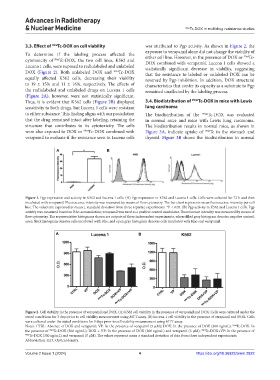
            3.3. Effect of  99m Tc-DOX on cell viability       was attributed to Pgp activity. As shown in Figure 2, the
                                                               exposure to verapamil alone did not change the viability of
            To determine if the labeling process affected the   either cell line. However, in the presence of DOX or  99m Tc-
            cytotoxicity of  99m Tc-DOX, the two cell lines, K562 and   DOX combined with verapamil, Lucena 1 cells showed a
            Lucena 1 cells, were exposed to radiolabeled and unlabeled   statistically significant decrease in viability, suggesting
            DOX (Figure  2).  Both unlabeled  DOX  and   99m Tc-DOX   that the resistance to labeled or unlabeled DOX can be
            equally affected K562  cells, decreasing their viability   reversed by Pgp inhibition. In addition, DOX structural
            to 19 ± 15% and 11 ± 16%, respectively. The effects of   characteristics that confer its capacity as a substrate to Pgp
            the radiolabeled and unlabeled drugs on Lucena 1  cells   remained unaffected by the labeling process.
            (Figure  2A), however, were not statistically significant.
            Thus, it is evident that K562  cells (Figure  2B) displayed   3.4. Biodistribution of  99]m Tc-DOX in mice with Lewis
            sensitivity to both drugs, but Lucena 1 cells were resistant   lung carcinoma
            to either substance. This finding aligns with our postulation   The biodistribution of the   99]m Tc-DOX was evaluated
            that the drug remained intact after labeling, retaining the   in normal mice and mice with Lewis lung carcinoma.
            structure that contributes to its cytotoxicity. The cells   The biodistribution results in normal mice, as shown in
            were also exposed to DOX or  99m Tc-DOX combined with   Figure  3A, indicate uptake of   99m Tc in the stomach and
            verapamil to evaluate if the resistance seen in Lucena cells   thyroid.  Figure  3B  shows  the  biodistribution  in  normal

                         A                    B


            Figure 1. Pgp expression and activity in K562 and Lucena 1 cells. (A) Pgp expression in K562 and Lucena 1 cells. Cells were cultured for 72 h and then
            incubated with verapamil. Fluorescence intensity was measured by means of flow cytometry. The bar chart represents mean fluorescence intensity per cell
            line. The values are expressed as mean ± standard deviation from three separate experiments. *P < 0.05. (B) Pgp activity in K562 and Lucena 1 cells. Pgp
            activity was measured based on Rho accumulation; verapamil was used as a positive control modulator. Fluorescence intensity was measured by means of
            flow cytometry. The representative histograms shown are outputs of three independent experiments, where filled gray histogram denotes negative control,
            open black histogram denotes cells incubated with Rho, and open gray histogram denotes cells incubated with Rho and verapamil.

                         A                                  B


            Figure 2. Cell viability in the presence of verapamil and DOX. (A) K562 cell viability in the presence of verapamil and DOX. Cells were cultured under the
            stated conditions for 3 days prior to cell viability measurement using MTT assay. (B) Lucena-1 cell viability in the presence of verapamil and DOX. Cells
            were cultured under the stated conditions for 3 days prior to cell viability measurement using MTT assay.
            Notes: CTRL: Absence of DOX and verapamil; VP: In the presence of verapamil (5 µM); DOX: In the presence of DOX (300 ng/mL);  99m Tc-DOX: In
            the presence of  99m Tc-DOX (300 ng/mL); DOX + VP: In the presence of DOX (300 ng/mL) and verapamil (5 µM);  99m Tc-DOX+VP: In the presence of
            99m Tc-DOX (300 ng/mL) and verapamil (5 µM). The values represent mean ± standard deviation of data from three independent experiments.
            Abbreviation: O.D.: Optical density.

            Volume 2 Issue 1 (2024)                         4                       https://doi.org/10.36922/arnm.2822

