


Page 10 - ARNM-2-4
P. 10
Advances in Radiotherapy
            & Nuclear Medicine                                                        Radionuclide-carrying liposomes


                                                                                                  ®
                                                                                                            ®
                                                                      ®
                                                                              ®
                                                                                        ®
            from the promotion of wound healing to the delivery   DepoCyt , Doxil , Lipodox , Myocet , Marqibo ,
            of cancer therapies. An example of how drug delivery   Vyxeos , Onivyde , Mepact , Ambisome , Arkayce ,
                                                                     ®
                                                                                                   ®
                                                                                                            ®
                                                                              ®
                                                                                       ®
            improves medicine is the use of nanofibers to deliver   Inflexal  V, Epaxel, DepoDur™, Exparel, and Visudyne .
                                                                     ®
                                                                                                            ®
            treatment to wounds while reducing the chance of bacteria   Nine of these drugs are intended for cancer treatment.
                                                                                                             7
            developing resistance to treatment. This method creates an   Since 1992, more than 1000 articles mentioning liposomes
            environment around the damaged tissue that promotes cell   have been published the National Library of Medicine each
            healing. 1,2                                       year, with over 3,500 articles published in 2023. Liposomes
                                                               are capsules composed of a lipid bilayer of phospholipids
              The use of nanocapsules for targeted drug delivery first   with hydrophilic heads and hydrophobic tails, which allow
            became a field of focus for researchers back in the early   for encapsulation of various compounds in different parts
            1950s.  Drug delivery using nanocapsules involves the   of the liposome.  Compounds that are soluble in water
                 3
                                                                            8
            encapsulation of a chosen drug or radionuclide in a specific   can be carried by the aqueous core of the liposome and
            material that can efficiently deliver the therapeutic agent   compounds that dissolve in lipids can be carried by the
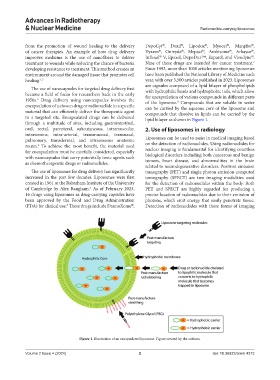
            to a targeted site. Encapsulated drugs can be delivered   lipid bilayer as shown in Figure 1.
            through a multitude of sites, including gastrointestinal,
            oral, rectal, parenteral, subcutaneous, intramuscular,   2. Use of liposomes in radiology
            intravenous, intra-arterial, transmucosal, transnasal,
            pulmonary, transdermal, and  intraosseous  anatomic   Liposomes can be used to assist in medical imaging based
            routes.  To achieve the most benefit, the material used   on the detection of radionuclides. Using radionuclides for
                 4
                                                               nuclear imaging is fundamental for identifying countless
            for encapsulation must be carefully considered, especially
            with nanocapsules that carry potentially toxic agents such   biological disorders including both cancerous and benign
            as chemotherapeutic drugs or radionuclides.        tumors, heart disease, and abnormalities in the brain
                                                               related to neurodegenerative disorders. Positron emission
              The use of liposomes for drug delivery has significantly   tomography (PET) and single photon emission computed
            increased in  the  past  few  decades.  Liposomes were  first   tomography (SPECT) are two imaging modalities used
            created in 1961 at the Babraham Institute of the University   for the detection of radionuclides within the body. Both
            of Cambridge by Alex Bangham.  As of February 2023,   PET and SPECT are highly regarded for producing a
                                       5
            16 drugs using liposomes as drug-carrying capsules have   precise location of radionuclides due to their emission of
            been approved by  the Food and Drug Administration   photons, which emit energy that easily penetrate tissue.
            (FDA) for clinical use.  These drugs include DaunoXome ,   Detection of radionuclides with these forms of imaging
                                                         ®
                             6


                                   Figure 1. Illustration of an encapsulated liposome. Figure created by the authors.


            Volume 2 Issue 4 (2024)                         2                              doi: 10.36922/arnm.4373

