


Page 15 - ARNM-2-4
P. 15
Advances in Radiotherapy
            & Nuclear Medicine                                                        Radionuclide-carrying liposomes


            tumor microenvironments as opposed to extravasation into
            healthy areas.  Stolarz et al.  developed a type of liposome
                       38
                                  39
            that offers control of release through X-ray irradiation. The
            experiment utilized the fact that chloral hydrate releases
            free protons after exposure to X-rays by incorporating it
            into the liposomal structure. The study showed that the
            treatment of tumors with liposomes paired with radiation
            showed more intense therapeutic effects compared to
            either the liposomes or radiation alone.

              Prabhakar  et al.  reported that the performance of
                            40
            liposomal drug delivery can be enhanced by directing
            ultrasonic waves toward a tumor during treatment with
            intravenously administered liposomes. Specifically, the
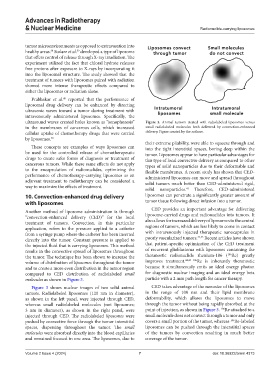
            ultrasound waves created holes known as “sonophoresis”   Figure  3. Animal tumors treated with  radiolabeled liposomes  versus
            in the membranes of cancerous cells, which increased   small radiolabeled molecules both delivered by convection-enhanced
            cellular uptake of chemotherapy drugs that were carried   delivery. Figure created by the authors.
            by liposomes. 40
                                                               their extreme pliability, were able to squeeze through and
              These concepts are examples of ways liposomes can   into the tight interstitial spaces, boring deep within the
            be used for the controlled release of chemotherapeutic   tumor. Liposomes appear to have particular advantages for
            drugs to create safer forms of diagnosis or treatment of   this type of local convective delivery as compared to other
            cancerous tumors. While these same effects do not apply   types of solid nanoparticles due to their deformable and
            to the encapsulation of radionuclides, optimizing the   flexible membranes. A recent study has shown that CED-
            performance of chemotherapy-carrying liposomes as an   administered liposomes can move and spread throughout
            adjuvant treatment to radiotherapy can be considered a   solid tumors much better than CED-administered rigid,
            way to maximize the effects of treatment.
                                                               solid nanoparticles.  Therefore, CED-administered
                                                                                41
            10. Convection-enhanced drug delivery              liposomes can penetrate a significantly greater amount of
            with liposomes                                     tumor tissue following direct infusion into a tumor.
                                                                 CED provides an important advantage for delivering
            Another method of liposome administration is through
            “convection-enhanced delivery (CED)” for the local   liposome-carried drugs and radionuclides into tumors. It
            treatment of tumors. Convection, in this particular   also allows for increased delivery of liposomes to the central
            application, refers to the pressure applied to a catheter   regions of tumors, which are less likely to come in contact
            from a syringe pump where the catheter has been inserted   with  intravenously  injected  therapeutic  nanocapsules  in
            directly into the tumor. Constant pressure is applied to   poorly vascularized tumors. 42,43  Recent articles have shown
            the injected fluid that is carrying liposomes. This method   that patient-specific optimization of the CED treatment
            results in the convective spread of liposomes throughout   of recurrent glioblastoma with liposomes containing the
                                                                                                  186
            the tumor. The technique has been shown to increase the   theranostic  radionuclide  rhenium-186  ( Re)  greatly
            volume of distribution of liposomes throughout the tumor   improves treatment. 44,45  186 Re is inherently theranostic
            and to create a more even distribution in the tumor region   because it simultaneously emits an ideal energy photon
            compared to CED distribution of radiolabeled  small   for diagnostic nuclear imaging and an ideal energy beta
            molecules as shown in Figure 3.                    particle with a 2 mm path length for cancer therapy.
              Figure  3 shows nuclear images of two solid animal   CED takes advantage of the nanosize of the liposomes
            tumors. Radiolabeled liposomes (120  nm in diameter),   in the range of 100  nm and their lipid membrane
            as shown in the left panel, were injected through CED,   deformability, which allows the liposomes to move
            whereas small radiolabeled molecules (not  liposomes;   through the tumor without being rapidly absorbed at the
                                                                                               186
            3  nm in diameter), as shown in the right panel, were   point of injection, as shown in Figure 3.  Re attached to a
            injected through CED. The radiolabeled  liposomes were   small molecule does not convect through a tumor and only
                                                                                                   186
            pushed by convective force through the tumor interstitial   covers a small portion of the tumor, whereas  Re-labeled
            spaces, dispersing throughout the tumor. The  small   liposomes can be pushed through the interstitial spaces
            molecules were absorbed directly into the blood capillaries   of  the  tumors by  convection  resulting  in  much  better
            and remained focused in one area. The liposomes, due to   coverage of the tumor.


            Volume 2 Issue 4 (2024)                         7                              doi: 10.36922/arnm.4373

