


Page 13 - ARNM-2-4
P. 13
Advances in Radiotherapy
            & Nuclear Medicine                                                        Radionuclide-carrying liposomes


            6. Diagnostic applications of radionuclide-        cells encounter when they metastasize from a cancerous
            containing liposomes                               site in the body. Localizing the sentinel lymph node and
                                                               removing it for pathological examination is important.
            Liposomes labeled with the most commonly used single
            photon agent,   99m Tc, were shown by Goins  et al. to be   A novel method of trapping liposomes in sentinel
                                                                                                      26
            useful for detecting sites of cancer, sites of infection, and   lymph nodes was developed by Zavaleta  et  al.  In this
                                                                      99m
            inflammation. 22,23  Investigators from the Netherlands have   method,   Tc-radiolabeled liposomes were coated with
            also shown the potential application of   99m Tc liposomes   biotin and simultaneously injected with avidin around a
                                                               tumor.  Their  results  showed both the  biotin and  avidin
            in detecting sites of infection and inflammation.    aggregating as they moved toward the sentinel lymph
                                                         24
            Liposomes accumulate  at  sites of  infection in  the  same   node and became entrapped. In this example, the   99m Tc-
            manner they accumulate in tumors following intravenous   liposomes also had encapsulated blue dye to guide the
            administration, by the EPR mechanism. An example of   surgeon’s radio-detection probe. The blue dye served as a
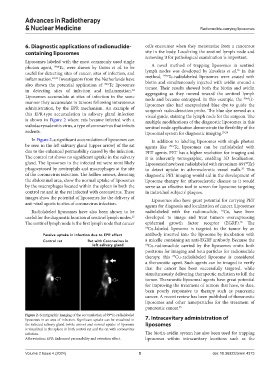
            this EPR-type accumulation in salivary gland infection   visual guide, staining the lymph node for the surgeon. The
            is shown in Figure 2 where rats became infected with a   multiple modifications of the diagnostic liposomes in this
            sialodacryoadenitis virus, a type of coronavirus that infects   sentinel node application demonstrate the flexibility of the
            rodents.                                           liposomal system for diagnostic imaging. 25,26
              In Figure 2, a significant accumulation of liposomes can   In addition to labeling liposomes with single photon
            be seen in the left salivary gland (upper arrow) of the rat   agents like   99m Tc, liposomes can be radiolabeled with
            due to the enhanced permeability caused by the infection.   PET agents. PET has a higher resolution for imaging and
            The control rat shows no significant uptake in the salivary   it is inherently tomographic, enabling 3D localization.
            gland. The liposomes in the infected rat were most likely   Liposomes have been radiolabeled with zirconium-89 ( Zr)
                                                                                                          89
            phagocytosed by neutrophils and macrophages at the site   to detect uptake in atherosclerotic vessel walls.  This
                                                                                                        27
            of the coronavirus infection. The hollow arrows, denoting   diagnostic PET imaging would aid in the development of
            the abdominal area, show the normal uptake of liposomes   liposome therapy for atherosclerotic disease as it would
            by the macrophages located within the spleen in both the   serve as an effective tool to screen for liposome targeting
            control rat and in the rat infected with coronavirus. These   in individual subjects’ plaques.
            images show the potential of liposomes for the delivery of   Liposomes also have great potential for carrying PET
            anti-viral agents to sites of coronavirus infection.  agents for diagnosis and localization of cancer. Liposomes
              Radiolabeled liposomes have also been shown to be   radiolabeled with the radionuclide,   64 Cu, have been
            useful for the diagnostic location of sentinel lymph nodes.    developed to image and treat tumors overexpressing
                                                         25
                                                                                                       28
            The sentinel lymph node is the first lymph node that cancer   epidermal  growth  factor  receptor  (EGRF).   The
                                                               64 Cu-labeled liposome is targeted to the tumor by an
                                                               antibody inserted into the liposome by incubation with
                                                               a micelle containing an anti-EGRF antibody. Because the
                                                               64 Cu-radionuclide carried by the liposomes emits both
                                                               positrons for imaging and beta particles for radionuclide
                                                               therapy, this  Cu-radiolabeled liposome is considered
                                                                          64
                                                               a theranostic agent. Such agents can be imaged to verify
                                                               that the cancer has been successfully targeted, while
                                                               simultaneously delivering therapeutic radiation to kill the
                                                               tumor. Theranostic liposomal agents have great potential
                                                               for improving the treatment of tumors that have, to date,
                                                               been poorly responsive to therapy such as pancreatic
                                                               cancer. A recent review has been published of theranostic
                                                               liposomes and other nanoparticles for the treatment of
                                                               pancreatic cancer. 28
            Figure 2. Scintigraphic imaging of the accumulation of 99 Tc-radiolabeled
                                                m
            liposomes in an area of infection. Significant uptake can be visualized in   7. Intracavitary administration of
            the infected salivary gland (white arrow) and normal uptake of liposome   liposomes
            is visualized in the spleen in both control rat and the rat with coronavirus
            infection.                                         The biotin-avidin system has also been used for trapping
            Abbreviation: EPR: Enhanced permeability and retention effect.  liposomes within intracavitary locations such as the


            Volume 2 Issue 4 (2024)                         5                              doi: 10.36922/arnm.4373

