Page 64 - ARNM-2-4
P. 64

Advances in Radiotherapy
            & Nuclear Medicine                                             Different approaches for the computation of BED


            defines the DVH.  From the definition of DVH,      σ. Consequently,  BED and the corresponding TCP are
                            39
                                     dDVH                    maximized in the case of a uniform target dose. This
            DVHD()−  DVHD( + ∆ D) ≈−       ∆ D  equals the                                                38
                                      dD                     conclusion agrees with the seminal result by Webb et al.
            relative volume of the target with the dose varying between   that a uniform dose provides the greatest TCP for a fixed
            D and  D+∆D. Consequently, the average probability of   integral dose in the target volume.
            survival in the target can be expressed as follows:  For a fixed alpha/beta ratio, BED  in Eq. (12) decreases
                                                                                           nud
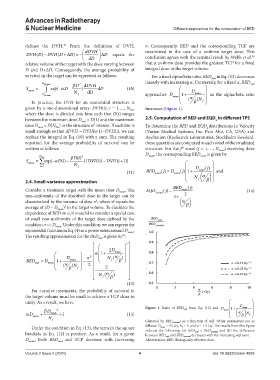
                                                               linearly with increasing α. Conversely, for a fixed α, BED
                   D tarmax,    β D 2  d DVH                                                               nud
            S mean  =−  ∫  exp −( α D −  )  d D        (10)                      D     
                   D tarmin,    N  f  d D                      approaches  D mean   1+  ( α mean    as the alpha/beta ratio
                                                                                     )
                                                                                       f
              In practice, the DVH  for an anatomical structure is               β  N  
            given by a one-dimensional array: DVH(i), i = 1,…, N ,   increases (Figure 1).
                                                        bin
            where the dose is divided into bins such that D(i) ranges
            between the minimum dose D  = D(1) and the maximum   2.5. Computation of BED and EQD  in different TPS
                                                                                             2
                                    min
            dose D max  = D(N ) in the structure of interest. If each bin is   To determine the BED and EQD distributions in Velocity
                         bin
                                                                                         2
            small enough so that dDVH ≈ DVH(i+1)−DVH(i), we can   (Varian Medical Systems, Inc. Palo Alto, CA, USA) and
            replace the integral in Eq. (10) with a sum. The resulting   RayStation (RaySearch Laboratories, Stockholm Sweden),
            equation for the average probability of survival can be   these quantities are computed in each voxel of the irradiated
            written as follows:                                structure. For the j  voxel (j = 1,…, N voxel ) receiving dose
                                                                              th
                                                               D   , the corresponding BED   is given by
                  N bin        β Di() 2                         voxel                 voxel
                ≈
            S mean ∑ exp( −α D i −()  )[ DVHi −()  DVHi +1(  )]                           
                  i=1           N  f                                               D    j () 
                                                       (11)    BED voxel  j () = D voxel  j ()1 +  voxel    and
                                                                                       α
                                                                                   N f( )  
            2.4. Small-variance approximation                                           β  
            Consider a treatment target with the mean dose D mean . The   EQD 2, voxel  j () =  BED voxel  j ()  (14)
            non-uniformity of the absorbed dose in the target can be       1+  2
                                                                              α
                                          2
                                                 2
            characterized by the variance of dose σ , where σ  equals the     ( )
                                                                                β
            average of (D – D mean )  in the target volume. To elucidate the
                             2
            dependence of BED on σ, it is useful to consider a special case
            of small non-uniformity of the target dose defined by the
            condition σ << D mean . Under this condition, we can express the
            exponential function in Eq. (4) as a power series around D mean .
            The resulting approximation for the BED  is given by :
                                                     40
                                           nud
                                                     2 
                                             2 D mean   
                                     2  α    1 +  α    
                                    −
            BED nud  = D mean   1 +  D mean   σ        N (  β )   
                                                f
                                                      
                                   
                           ( α  ) N   2    2
                                  f
                             β         −              
                                             α         
                                            N (  β )   
                                             f
                                                       (12)
              For curative treatments, the probability of survival in
            the target volume must be small to achieve a TCP close to
            unity. As a result, we have                                                                    
                                                               Figure  1. Ratio of  BED nud  from Eq. (12) and  D   1+  D mean  
                    β D  2                                                                      mean     α    
            αD mean  +  N mean  >1                     (13)                                              β   N f  
                       f
                                                               follows: D mean  = 55 Gy, N f  = 5, and σ = 1.5 Gy. The results from this figure
              Under the condition in Eq. (13), the term in the square   (denoted by  BED nominal ) as a  function of  α/β. Other parameters are as
                                                               indicate the following: (a)  BED nud  <  BED nominal  and (b) the difference
            brackets in Eq. (12) is positive. As a result, for a given   between BED nud  and BED nominal  decreases with the increasing α/β ratio.
            D mean , both  BED  and TCP decrease with increasing   Abbreviation: BED: Biologically effective dose.
                          nud
            Volume 2 Issue 4 (2024)                         4                              doi: 10.36922/arnm.4826
   59   60   61   62   63   64   65   66   67   68   69