


Page 67 - ARNM-2-4
P. 67
Advances in Radiotherapy
            & Nuclear Medicine                                             Different approaches for the computation of BED


            Table 2. Computed dosimetric and radiobiological     Second, in the employed radiobiological model,
            parameters for the considered stereotactic body radiation   the radiation-induced cell kill during each fraction is
            therapy cases                                      independent of cell irradiation during previous fractions.
                                                               That is, damage repair, reoxygenation, and redistribution
            Parameter        DCA        VMAT       P-value*
                                                               of the cell cycle occur only between successive treatment
            σ                3.5±0.7    1.6±0.5     <0.001     fractions. A  detailed analysis of these effects, recently
                                                                         50
            Dmean           56.1±1.1    52.9±0.9    <0.001     reviewed in,  is beyond the scope of this study.
            BEDmean         119.4±3.7  108.8±2.7    <0.001       In this study, BED   and BED  were computed for
                                                                                 mean
                                                                                           nud
            BEDnud (α=0.15)  109.6±0.7  106.7±1.5   <0.001     the PTV, which encompasses the clinical target volume
            BEDnud (α=0.35)  101.1±2.5  103.6±0.8   <0.001     (CTV). Because the PTV is always larger than the CTV,
                                  –
                                          –
            Each parameter q is presented as q±std, where q and std denote the   the variance of the dose in the PTV normally exceeds the
            sample mean and sample standard deviation of q, respectively. In this   corresponding dose variance in the CTV. As a result, if the
            table, σ, Dmean, and BEDs are in Gray, whereas the parameter alpha has
            a unit of Gy .                                     CTV or gross tumor volume is used for the computation
                    −1
            *P<0.05 was considered significant.                of BED, the effect of dose non-uniformity on BED will be
            Abbreviations: DCA: Dynamic conformal arc; VMAT: Volumetric   smaller than that determined in our study.
            modulated arc therapy.
                                                                 Given the limitations of the employed LQ model,
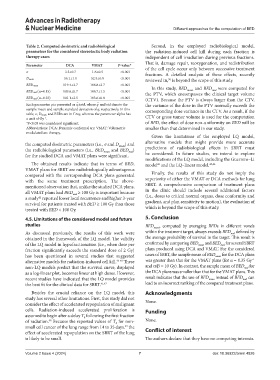
            the computed dosimetric parameters (i.e., σ and D mean ) and   alternative models that might provide more accurate
            the radiobiological parameters (i.e., BED mean  and BED )   predictions of radiobiological effects in SBRT must
                                                        nud
            for the studied DCA and VMAT plans were significant.  be considered. In future studies, we intend to explore
                                                               modifications of the LQ model, including the Guerrero–Li
              The obtained results indicate that in terms of  BED,   model  and the LQ–linear model. 45,46
                                                                    43
            VMAT plans for SBRT are radiobiologically advantageous
            compared with the corresponding DCA plans generated   Finally, the results of this study do not imply the
            with the same treatment prescription. The above-   superiority of either the VMAT or DCA methods for lung
            mentioned observation that, unlike the studied DCA plans,   SBRT. A  comprehensive comparison of treatment plans
            all VMAT plans had BED nud  ≥ 100 Gy is important because   in  the  clinic  should  include  several  additional  factors
                 42
            a study  reported lower local recurrence and higher 3-year   (i.e., doses to critical normal organs, dose conformity and
            survival for patients treated with BED ≥ 100 Gy than those   gradient, and plan sensitivity to motion), the evaluation of
            treated with BED < 100 Gy.                         which is beyond the scope of this study.
            4.5. Limitations of the considered model and future   5. Conclusion
            studies                                            BED mean ,  computed  by  averaging  BEDs  in  different  voxels
            As discussed previously, the results of this work were   within the treatment target, always exceeds BED  defined by
                                                                                                   nud
            obtained in the framework of the LQ model. The validity   the average probability of survival in the target. This result is
            of the LQ model in hypofractionation (i.e., when dose per   confirmed by comparing BED mean  and BED  for several SBRT
                                                                                               nud
            fraction significantly exceeds the standard dose of 2 Gy)   plans produced using DCA and VMAT. For the considered
            has been questioned in several studies that suggested   cases of SBRT, the sample mean of BED mean  for the DCA plans
                                                                                                            −1
            alternative models for radiation-induced cell kill. 43-46  These   was greater than that for the VMAT plans (for α = 0.35 Gy
            non-LQ models predict that the survival curve, displayed   and α/b = 10 Gy). In contrast, the sample mean of BED  for
                                                                                                         nud
            as a log-linear plot, becomes linear at high doses. However,   the DCA plans was smaller than that for the VMAT plans. This
            recent studies have indicated that the LQ model provides   result indicates that the use of BED mean  instead of BED  can
                                                                                                        nud
            the best fit for the clinical data for SBRT. 41,47  lead to an incorrect ranking of the compared treatment plans.
              Besides the crucial reliance on the LQ model, this   Acknowledgments
            study has several other limitations. First, this study did not
            consider the effect of accelerated repopulation of malignant   None.
            cells.  Radiation-induced accelerated proliferation is   Funding
            assumed to begin after a delay T  following the first fraction
                                     k
            of radiation.  Because the reported values of T  for non-  None.
                      48
                                                  k
                                                      49
            small cell cancer of the lung range from 14 to 35 days.  the
            effect of accelerated repopulation on the SBRT of the lung   Conflict of interest
            is likely to be small.                             The authors declare that they have no competing interests.
            Volume 2 Issue 4 (2024)                         7                              doi: 10.36922/arnm.4826

