


Page 105 - ARNM-3-3
P. 105
Advances in Radiotherapy
            & Nuclear Medicine                                                             Sarcomatoid HCC therapy


              In May 2024, the patient was hospitalized due to   differentiation, higher recurrence rates, and worse
            extreme fatigue, jaundice, dark urine, right upper quadrant   prognosis.  Patients with SHC exhibit shorter disease-
                                                                       2
            abdominal pain, and anorexia. Laboratory tests indicated   free survival and overall survival than those with non-
            liver failure, characterized by thrombocytopenia, elevated   sarcomatous HCC. 2
            liver enzymes, hyperbilirubinemia, and decreased albumin   At present, there is no specific biomarker for
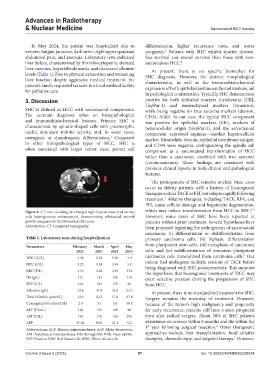
            levels (Table 1). Due to physical exhaustion and worsening   SHC diagnosis. However, the distinct morphological
            liver  function  despite aggressive medical  treatment,  the   characteristics,  as  well  as  the  immunohistochemical
            patient’s family requested transfer to a local medical facility   expression of both epithelial and mesenchymal markers, aid
            for palliative care.
                                                               in pathological confirmation. Typically, SHC demonstrates
            3. Discussion                                      positive for both epithelial markers (cytokeratin [CK],
                                                               HepPar-1) and mesenchymal markers (vimentin),
            SHC is defined as HCC with sarcomatoid components.   while being negative for true sarcoma markers (desmin,
            The accurate diagnosis relies on histopathological   CD34, S100). In our case, the typical HCC component
            and immunohistochemical features. Primary SHC is   was  positive  for  epithelial  markers  (CK),  markers  of
            characterized by spindle-shaped cells with pleomorphic   hepatocellular origin (HepPar-1), and the sarcomatoid
            nuclei, abundant mitotic activity, and, in some cases,   component  expressed  arginase—another  hepatocellular
            osteogenic or chondrogenic differentiation.  Compared   marker. Meanwhile, desmin, epithelial membrane antigen,
                                                2
            to other histopathological types of HCC, SHC is    and CD34 were negative, distinguishing the spindle cell
            often associated with larger tumor sizes, poorer cell   component as  a sarcomatoid transformation  of HCC
                                                               rather than a carcinoma combined with true sarcoma
                                                               (carcinosarcoma).  These  findings  are  consistent  with
                                                               previous clinical reports in both clinical and pathological
                                                               features.

                                                                 The pathogenesis of SHC remains unclear. Most cases
                                                               occur in elderly patients with a history of locoregional
                                                               therapies such as TACE or PEI, but relapse rapidly following
                                                                       1
                                                               treatment.  Ablative therapies, including TACE, RFA, and
                                                               PEI, cause cellular damage and hepatocyte degeneration,
                                                                                                            3-5
            Figure 8. CT scan revealing an enlarged right hepatic mass (red arrow)   which may induce transformation from HCC to SHC.
            with heterogeneous enhancement, demonstrating substantial interval   However, some cases of SHC have been reported in
            growth compared to the November 2023 scan.         patients without prior treatment. Several hypotheses have
            Abbreviation: CT: Computed tomography.             been proposed regarding the pathogenesis of sarcomatoid
                                                               carcinoma:  (i)  differentiation  or  dedifferentiation  from
            Table 1. Laboratory tests during hospitalization   primary carcinoma cells, (ii) biphasic differentiation

            Parameters          February   March   April   May   from pluripotent stem cells, (iii) metaplasia of carcinoma
                                 2024    2024   2024  2024     cells, and (iv) redifferentiation of immature pluripotent
                                                                                                         6
            WBC (G/L)             4.38    2.85   5.36  4.9     carcinoma cells transformed from carcinoma cells.  Our
            NEU (G/L)             3.23    1.34   3.99  3.5     patient had undergone multiple sessions of TACE before
                                                               being diagnosed with SHC postoperatively. This supports
            RBC (T/L)             4.33    3.62   3.59  3.54    the hypothesis that locoregional treatments of HCC may
            Hb (g/L)              131     113    100   119     exert selective pressure driving the progression of SHC
            PLT (G/L)             210     184    175   84      from HCC.
            Albumin (g/L)         43.8    37.8   34.6  23.4      At present, there is no standardized treatment for SHC.
            Total bilirubin (µmol/L)  13.0  12.5  17.8  67.8   Surgery remains the mainstay of treatment. However,
            Conjugated bilirubin (U/L)  2.9  3.1  5.5  48.5    because of the tumor’s high malignancy and propensity
            ALT (U/mL)            128     129    109   86      for early recurrence, patients still have a poor prognosis
            AST (U/L)             150     170    128   299     even after radical surgery. About 50% of SHC patients
            AFP                   17.62   N/A    33.1  72.1    experience recurrence within 6 months and die within the
                                                                                             2
                                                                st
            Abbreviations: ALT: Alanine aminotransferase; AFP: Alpha-fetoprotein;   1   year following surgical resection.  Other therapeutic
            AST: Aspartate aminotransferase; Hb: Hemoglobin; NEU: Neutrophils;   approaches  include  liver  transplantation,  local  ablative
                                                                                                     7
            PLT: Platelets; RBC: Red blood cells; WBC: White blood cells.  therapies, chemotherapy, and targeted therapy.  However,
            Volume 3 Issue 3 (2025)                         97                        doi: 10.36922/ARNM025220024

