


Page 26 - ARNM-3-3
P. 26
Advances in Radiotherapy
            & Nuclear Medicine                                    Brachytherapy versus external beam in local dose escalation


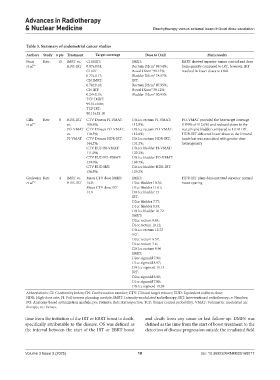
            Table 3. Summary of endometrial cancer studies
            Authors  Study n pts Treatment  Target coverage    Dose to OAR               Main results
            Pinzi   Retr  15  IMRT vs.   CI IMRT:        IMRT:                IMRT showed superior tumor control and dose
            et al. 16        HDR-IRT  0.97±0.01;         Rectum D2cm  89.54%;  homogeneity compared to IRT; however, IRT
                                                                   3
                                      CI IRT:            Bowel D2cm  91.15%;  resulted in lower doses to OAR
                                                                 3
                                      0.73±0.17;         Bladder D2cm  78.57%
                                                                   3
                                      CN IMRT:           IRT:
                                      0.78±0.10;         Rectum D2cm  47.95%;
                                                                   3
                                      CN IRT:            Bowel D2cm  39.12%;
                                                                 3
                                      0.24±0.15;         Bladder D2cm  30.95%
                                                                   3
                                      TCP IMRT:
                                      99.51±0.88;
                                      TCP IRT:
                                      80.13±25.10
            Cilla   Retr  8  HDR-IRT   CTV Dmean FI-VMAT:  D0.1cc rectum FI-VMAT:  PO-VMAT provided the best target coverage
            et al. 17        vs.      108.6%;            112.0%;              (D99% of 112.6%) and reduced doses to the
                             PO-VMAT  CTV Dmean PO-VMAT:  D0.1cc rectum PO-VMAT:  rectum and bladder compared to HDR-IRT.
                             vs.      118.5%;            112.0%;              HDR-IRT delivered lower doses to the femoral
                             FI-VMAT  CTV Dmean HDR-IRT:  D0.1cc rectum HDR-IRT:  heads but was associated with greater dose
                                      144.2%;            131.2%;              heterogeneity
                                      CTV EUD FI-VMAT:   D0.1cc bladder FI-VMAT:
                                      111.0%;            129.2%;
                                      CTV EUD PO-VMAT:   D0.1cc bladder PO-VMAT:
                                      130.0%;            108.7%;
                                      CTV EUD IRT:       D0.1cc bladder HDR-IRT:
                                      136.9%;            129.2%
            Grelewicz  Retr  4  IMRT vs.   Mean CTV dose IMRT:  IMRT:         HDR-IRT plans demonstrated superior normal
            et al. 18        HDR-IRT  14.8;              D2cc bladder 10.76;  tissue sparing
                                      Mean CTV dose IRT  D1cc bladder 11.61;
                                      14.9               D0.1cc bladder 13
                                                         IRT:
                                                         D2cc bladder 7.77;
                                                         D1cc bladder 8.93;
                                                         D0.1cc bladder 10.72
                                                         IMRT:
                                                         D2cc rectum 8.84;
                                                         D1cc rectum 10.12;
                                                         D0.1cc rectum 12.72
                                                         IRT:
                                                         D2cc rectum 6.57;
                                                         D1cc rectum 7.6;
                                                         D0.1cc rectum 9.96
                                                         IMRT:
                                                         D2cc sigmoid 7.91;
                                                         D1cc sigmoid 8.97;
                                                         D0.1cc sigmoid 11.13
                                                         IRT:
                                                         D2cc sigmoid 6.08;
                                                         D1cc sigmoid 7.08;
                                                         D0.1cc sigmoid 10.39
            Abbreviations: CI: Conformity index; CN: Conformation number; CTV: Clinical target volume; EUD: Equivalent uniform dose;
            HDR: High-dose rate; FI: Full-inverse planning module; IMRT: Intensity-modulated radiotherapy; IRT: Interventional radiotherapy; n: Number;
            PO: Anatomy-based optimization module; pts: Patients; Retr: Retrospective; TCP: Tumor control probability; VMAT: Volumetric modulated arc
            therapy; vs.: Versus.

            time from the initiation of the IRT or EBRT boost to death,   and death from any cause or last follow-up. DMFS was
            specifically attributable to the disease. OS was defined as   defined as the time from the start of boost treatment to the
            the interval between the start of the IRT or EBRT boost   detection of disease progression outside the irradiated field


            Volume 3 Issue 3 (2025)                         18                        doi: 10.36922/ARNM025160017

