


Page 28 - ARNM-3-3
P. 28
Advances in Radiotherapy
            & Nuclear Medicine                                    Brachytherapy versus external beam in local dose escalation


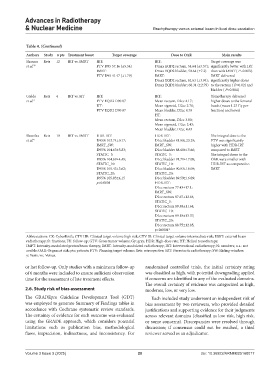
            Table 4. (Continued)
            Authors  Study  n pts Treatment boost  Target coverage        Dose to OAR          Main results
            Sharma   Retr  12  IRT vs. IMRT  IRT:                  IRT:                    Target coverage was
            et al. 25                     PTV D95 57.16 (±5.54)    Dmax EQD2 rectum, 54.64 (±3.57); significantly better with IRT
                                          IMRT:                    Dmax EQD2 bladder, 50.64 (±7.2)  than with IMRT ( P=0.003).
                                          PTV D95 41.47 (±1.79)    IMRT:                   IMRT delivered
                                                                   Dmax EQD2 rectum, 62.63 (±3.94); significantly higher doses
                                                                   Dmax EQD2 bladder; 66.31 (±2.79) to the rectum ( P=0.02) and
                                                                                           bladder ( P=0.004)
            Gielda   Retr  4  IRT vs. HT  IRT:                     IRT:                    Tomotherapy delivered
            et al. 3                      PTV EQD2 D90 87          Mean rectum, D2cc 4.17;  higher doses to the femoral
                                          HT:                      Mean sigmoid, D2cc 2.70;  heads (mean 1.23 Gy per
                                          PTV EQD2 D90 87          Mean bladder, D2cc 4.70  fraction) and bowel
                                                                   HT:
                                                                   Mean rectum, D2cc 3.80;
                                                                   Mean sigmoid, D2cc 2.43;
                                                                   Mean bladder, D2cc 4.43
            Shwetha   Retr  10  IRT vs. IMRT  HDR-IRT:             HDR-IRT:                The integral dose to the
            et al. 4                      D95% 103.74±0.17;        D1cc bladder 81.00±23.29;  PTV was significantly
                                          IMRT_SW:                 IMRT_SW:                higher with HDR-IRT
                                          D95% 104.63±3.83;        D1cc bladder 88.68±15.66;  compared to IMRT
                                          STATIC_5:                STATIC_5:               The integral doses to the
                                          D95% 104.69±4.49;        D1cc bladder 91.71±17.08;  OAR were smaller with
                                          STATIC_10:               STATIC_10:              HDR-IRT as compared to
                                          D95% 105.43±3.62;        D1cc bladder 90.03±16.08;  IMRT
                                          STATIC_20:               STATIC_20:
                                          D95% 105.03±4.15         D1cc bladder 89.59±16.09;
                                          p<0.0001                 HDR-IRT:
                                                                   D1cc rectum 77.43±17.1;
                                                                   IMRT_SW:
                                                                   D1cc rectum 87.67±12.64;
                                                                   STATIC_5:
                                                                   D1cc rectum 89.58±11.64;
                                                                   STATIC_10:
                                                                   D1cc rectum 89.18±13.37;
                                                                   STATIC_20:
                                                                   D1cc rectum 88.75±12.85;
                                                                   p<0.0001*
            Abbreviations: CK: CyberKnife; CTV HR: Clinical target volume high risk; CTV IR: Clinical target volume intermediate risk; EBRT: external beam
            radiotherapy; fr: fractions; FU: follow-up; GTV: Gross tumor volume; Gy: gray; HDR: High-dose rate; HT: Helical tomotherapy;
            IMPT: Intensity-modulated proton beam therapy; IMRT: Intensity-modulated radiotherapy; IRT: Interventional radiotherapy; N: numbers; n.a.: not
            avaible; OAR: Organs at risk; pts: patients; PTV: Planning target volume; Retr: retrospective; SRT: Stereotactic radiotherapy; SW: Sliding-window;
            y: Years, vs.: Versus.

            or last follow-up. Only studies with a minimum follow-up   randomized controlled trials, the initial certainty rating
            of 6 months were included to ensure sufficient observation   was classified as high, with potential downgrading applied
            time for the assessment of late treatment effects.  if concerns are identified in any of the evaluated domains.
                                                               The overall certainty of evidence was categorized as high,
            2.6. Study risk of bias assessment                 moderate, low, or very low.
            The GRADEpro Guideline Development Tool (GDT)        Each included study underwent an independent risk of
            was employed to generate Summary of Findings tables in   bias assessment by two reviewers, who provided detailed
            accordance  with  Cochrane  systematic  review  standards.   justifications and supporting evidence for their judgments
            The certainty of evidence for each outcome was evaluated   across relevant domains (classified as low risk, high risk,
            using the GRADE approach, which considers potential   or some concerns). Discrepancies were resolved through
            limitations such as publication bias, methodological   discussion; if consensus could not be reached, a third
            flaws, imprecision, indirectness, and inconsistency. For   reviewer served as an adjudicator.


            Volume 3 Issue 3 (2025)                         20                        doi: 10.36922/ARNM025160017

