


Page 95 - ARNM-3-3
P. 95
Advances in Radiotherapy
            & Nuclear Medicine                                                   Cripto-1 in cancer diagnosis and therapy


            being the most common subtype, accounting for over
            90% of cases. OSCC has a poor prognosis, with a 5-year
            survival rate ranging between 50% and 55%.  Similar
                                                  55
            to other malignancies, OSCC is driven by genetic and
            environmental  factors,  and  lymph  node  metastasis  is  a
            key  contributor  to  its  poor  outcomes.  Investigating  the
            biological mechanisms underlying OSCC metastasis is
            crucial for understanding its pathogenesis and identifying
            potential therapeutic targets. Yoon et al.  first reported an
                                            56
            association between Cripto-1 and OSCC, demonstrating
            high levels of membrane-bound Cripto-1 expression
            in OSCC tissues. Their findings suggest that Criop-1
            contributes  to  malignant  transformation  by  promoting
            tumor cell proliferation and migration. Jain et al.  detected
                                                  57
            Cripto-1 in the serum of OSCC patients across various age
            groups and genders, noting elevated levels during the early
            stages of OSCC, which declined as the tumor progressed.
            In contrast, another study found no significant variation in
            Cripto-1 staining intensity across OSCC stages, although
            Nodal expression (a Cripto-1 binding partner) did correlate
            with tumor stage.  This discrepancy may stem from the
                          58
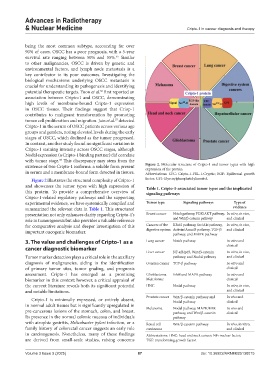
            existence of two Cripto-1 isoforms: a soluble form present   Figure  2.  Molecular  structure  of  Cripto-1  and  tumor  types  with  high
                                                               expression of the protein
            in serum and a membrane-bound form detected in tissues.  Abbreviations: CFC: Cripto-1-FRL-1-Cryptic; EGF: Epidermal growth
              Figure 2 illustrates the structural complexity of Cripto-1   factor; GPI: Glycosylphosphatidylinositol.
            and showcases the tumor types with high expression of   Table 1. Cripto‑1‑associated tumor types and the implicated
            this protein. To provide a comprehensive overview of   signaling pathways
            Cripto-1-related regulatory pathways and the supporting
            experimental evidence, we have systemically compiled and   Tumor type  Signaling pathways  Type of
            summarized the relevant data in Table 1. This structured                                evidence
            presentation not only enhances clarity regarding Cripto-1’s   Breast cancer  Notch pathway, PI3K/AKT pathway,  In vitro, in vivo,
            role in tumorigenesis but also provides a valuable reference   and Wnt/β-catenin pathway  and clinical
            for comparative analysis and deeper investigation of this   Cancers of the   KRAS pathway, Src/Akt pathway,  In vitro, in vivo,
            important oncogenic biomarker.                     digestive system Activin/Amad3 pathway, TGF-β   and clinical
                                                                           pathway, and MAPK pathway
            3. The value and challenges of Cripto-1 as a       Lung cancer  Notch pathway        In vitro and
            cancer diagnostic biomarker                                                          clinical
                                                               Liver cancer  NF-κB/p65, Wnt/β-catenin   In vitro, in vivo,
            Tumor marker detection plays a critical role in the auxiliary   pathway, and Nodal pathway  and clinical
            diagnosis  of  malignancies,  aiding  in the  identification   Ovarian cancer TGF-β pathway  In vitro and
            of primary tumor sites, tumor grading, and prognosis                                 clinical
            assessment. Cripto-1 has emerged as a promising    Glioblastoma   ErbB and MAPK pathway  In vitro and
            biomarker in this context; however, a critical appraisal of   Multiforme             clinical
            the current literature reveals both its significant potential   HNC  Nodal pathway   In vitro, in vivo,
            and notable limitations.                                                             and clinical
                                                               Prostate cancer  Wnt/β-catenin pathway and   In vivo and
              Cripto-1 is minimally expressed, or entirely absent,         Nodal pathway         clinical
            in normal adult tissues but is significantly upregulated in
            pre-cancerous lesions of the stomach, colon, and breast.   Melanoma  Nodal pathway, MAPK/ERK   In vivo and
                                                                                                 clinical
                                                                           pathway, and Wnt/β-catenin
            Its presence in the normal colonic mucosa of individuals       pathway
            with atrophic gastritis, Helicobacter pylori infection, or a   Renal cell   Wnt/β-catenin pathway  In vivo, in vitro,
            family history of colorectal cancer suggests an early role   carcinoma               and clinical
            in carcinogenesis. Nonetheless, many of these findings   Abbreviations: HNC: head and neck cancer; NF: nuclear factor;
            are  derived  from  small-scale  studies,  raising concerns   TGF: transforming growth factor.

            Volume 3 Issue 3 (2025)                         87                        doi: 10.36922/ARNM025130015

