


Page 34 - BH-1-1
P. 34
Brain & Heart                                             Atropine can reducing reperfusion vagal reflex in STEMI


            rate of <60 beats/min (bpm) ; and ventricular tachycardia
                                  [8]
            was defined as a series of more than three consecutive
            premature ventricular complexes at a rate faster than
            100 bpm .
                   [9]
            2.5. Statistical analysis
            The  Kolmogorov–Smirnov  test  was  used  to  test  the
            normality of the distribution. Continuous variables
            were presented as means and standard deviations, and
            unpaired t-tests and Mann–Whitney tests were used
            for comparisons between the two groups. Categorical
            variables  were  presented  as frequencies  and percentages
            and were compared using Chi-squared test. P < 0.05 was
            considered statistically significant for all analyses, which
            were performed using SPSS 26.0.
            3. Results

            3.1. Characteristics of the study participants
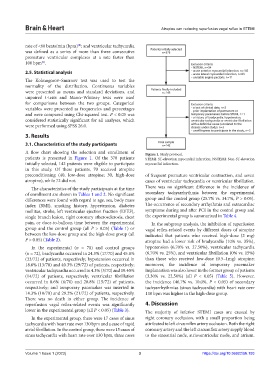
            A flow  chart showing the selection and enrollment of   Figure 1. Study protocol.
            patients is presented in  Figure  1. Of the 378  patients   STEMI: ST-elevation myocardial infarction; NSTEMI: Non-ST-elevation
            initially selected, 142 patients were eligible to participate   myocardial infarction.
            in this study. Of these patients, 70 received atropine
            preconditioning (40, low-dose atropine; 30, high-dose   of frequent premature ventricular contraction, and seven
            atropine), while 72 did not.                       cases of ventricular tachycardia or ventricular fibrillation.
              The characteristics of the study participants at the time   There  was no  significant  difference in  the  incidence of
            of enrollment are shown in Tables 1 and 2. No significant   secondary tachyarrhythmia between the experimental
            differences were found with regard to age, sex, body mass   group and the control group (25.7% vs. 34.7%, P > 0.05).
            index (BMI), smoking history, hypertension, diabetes   The occurrence of secondary arrhythmia and extracardiac
            mellitus, stroke, left ventricular ejection fraction (LVEF),   symptoms during and after PCI in the control group and
            single branch lesion, right coronary atherosclerosis, chest   the experimental group is summarized in Table 4.
            pain, or door-to-balloon time between the experimental   In the subgroup analysis, the inhibition of reperfusion
            group and the control group (all  P > 0.05) (Table 1) or   vagal reflex-related events by different doses of atropine
            between the low-dose group and the high-dose group (all   indicated  that  patients  who  received  high-dose  (2  mg)
            P > 0.05) (Table 2).                               atropine had a lower risk of bradycardia (10% vs. 35%),
              In  the  experimental  (n  =  70) and  control  groups   hypotension  (6.70%  vs.  27.50%),  ventricular  tachycardia
            (n = 72), bradycardia occurred in 24.3% (17/70) and 45.8%   (6.70% vs. 25%), and ventricular fibrillation (0% vs. 15%)
            (33/72) of patients, respectively; hypotension occurred in   than those who received low-dose (0.5–1mg) atropine;
            18.6% (13/70) and 40.3% (29/72) of patients, respectively;   moreover, the incidence of temporary pacemaker
            ventricular tachycardia occurred in 4.3% (3/70) and 19.40%   implantation was also lower in the former group of patients
            (14/72) of patients, respectively; ventricular fibrillation   (3.30% vs. 22.50%) (all  P < 0.05) (Table 5). However,
            occurred in 8.6% (6/70) and 20.8% (15/72) of patients,   the incidence (46.7% vs. 10.0%,  P < 0.05) of secondary
            respectively; and temporary pacemaker was inserted in   tachyarrhythmias (sinus tachycardia) with heart rate over
            14.3% (10/70) and 29.2% (21/72) of patients, respectively.   130 bpm was higher in the high-dose group.
            There was no death in  either group.  The incidence  of
            reperfusion vagal reflex-related events was significantly   4. Discussion
            lower in the experimental group (all P < 0.05) (Table 3).  The majority of inferior STEMI cases are caused by
              In the experimental group, there were 17 cases of sinus   right coronary occlusion, with a small proportion being
            tachycardia with heart rate over 130 bpm and a case of rapid   attributed to left circumflex artery occlusion. Both the right
            atrial fibrillation. In the control group, there were 15 cases of   coronary artery and the left circumflex artery supply blood
            sinus tachycardia with heart rate over 130 bpm, three cases   to the sinoatrial node, atrioventricular node, and atrium.


            Volume 1 Issue 1 (2023)                         3                          https://doi.org/10.36922/bh.193

