


Page 36 - BH-1-1
P. 36
Brain & Heart                                             Atropine can reducing reperfusion vagal reflex in STEMI


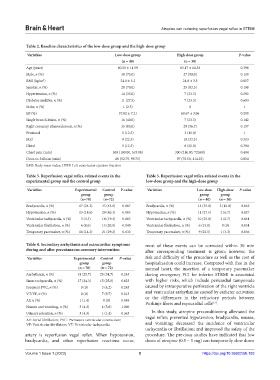
            Table 2. Baseline characteristics of the low‑dose group and the high‑dose group
             Variables                            Low‑dose group            High‑dose group            P‑value
                                                     (n = 40)                  (n = 30)
            Age (years)                            60.50 ± 11.59              63.17 ± 14.53            0.396
            Male, n (%)                              30 (75.0)                 27 (90.0)               0.110
            BMI (kg/m )                             24.0 ± 3.2                 24.8 ± 3.5              0.857
                   2
            Smoker, n (%)                            28 (70.0)                 25 (83.3)               0.198
            Hypertension, n (%)                      14 (35.0)                 7 (23.3)                0.292
            Diabetes mellitus, n (%)                 11 (27.5)                 7 (23.3)                0.693
            Stoke, n (%)                             1 (2.5)                      0                      1
            EF (%)                                  57.82 ± 7.21              60.67 ± 3.06             0.200
            Single branch lesion, n (%)              16 (40.0)                 7 (23.3)                0.142
            Right coronary atherosclerosis, n (%)    35 (85.0)                 29 (96.7)               0.107
            Proximal                                 5 (12.5)                  3 (10.0)                  1
            Mid                                      9 (22.5)                  10 (33.3)               0.313
            Distal                                   5 (12.5)                  6 (20.0)                0.394
            Chest pain (min)                     300 (180.00, 519.00)      300 (216.00, 720.00)        0.494
            Door-to-balloon (min)                 80 (52.75, 99.75)         97 (70.50, 114.25)         0.054
            BMI: Body mass index; LVEF: Left ventricular ejection fraction

            Table 3. Reperfusion vagal reflex‑related events in the   Table 5. Reperfusion vagal reflex‑related events in the
            experimental group and the control group           low‑dose group and the high‑dose group

             Variables           Experimental   Control   P‑value  Variables         Low‑dose   High‑dose   P‑value
                                    group    group                                    group    group
                                   (n=70)    (n=72)                                  (n = 40)  (n = 30)
            Bradycardia, n (%)     17 (24.3)  33 (45.8)  0.007  Bradycardia, n (%)   14 (35.0)  3 (10.0)  0.016
            Hypotension, n (%)     13 (18.6)  29 (40.3)  0.005  Hypotension, n (%)   11 (27.5)  2 (6.7)  0.027
            Ventricular tachycardia, n (%)  3 (4.3)  14 (19.4)  0.005  Ventricular tachycardia, n (%)  10 (25.0)  2 (6.7)  0.044
            Ventricular fibrillation, n (%)  6 (8.6)  15 (20.8)  0.040  Ventricular fibrillation, n (%)  6 (15.0)  0 (0)  0.034
            Temporary pacemaker, n (%)  10 (14.3)  21 (29.2)  0.032  Temporary pacemaker, n (%)  9 (22.5)  1 (3.3)  0.036

            Table 4. Secondary arrhythmia and extracardiac symptoms   most of these events can be corrected within 30  min
            during and after percutaneous coronary intervention  after corresponding treatment is given; however, the
             Variables          Experimental   Control   P‑value  risk and difficulty of the procedure as well as the cost of
                                   group    group              hospitalization could increase. Compared with that in the
                                  (n = 70)  (n = 72)           normal  heart,  the  insertion  of  a  temporary  pacemaker
            Arrhythmia, n (%)     18 (25.7)  25 (34.7)  0.243  during emergency PCI for inferior STEMI is associated
            Sinus tachycardia, n (%)  17 (24.3)  15 (25.8)  0.623  with higher risks, which include pericardial tamponade
            Frequent PVC, n (%)    0 (0)    3 (4.2)  0.245     caused by intraoperative perforation of the right ventricle
            VT/VF, n (%)           0 (0)    7 (9.7)  0.013     and ventricular arrhythmias caused by catheter activation
            AF, n (%)              1 (1.4)   0 (0)   0.049     or the differences in the refractory periods between
                                                               Purkinje fibers and myocardial cells .
                                                                                           [17]
            Nausea and vomiting, n (%)  3 (4.3)  4 (5.6)  1.000
            Urinary retention, n (%)  3 (4.3)  1 (1.4)  0.363    In this study, atropine preconditioning alleviated the
                                                               vagal reflex; prevented hypotension, bradycardia, nausea,
            AF: Atrial fibrillation; PVC: Premature ventricular contraction;
            VF: Ventricular fibrillation; VT: Ventricular tachycardia  and vomiting; decreased the incidence of ventricular
                                                               tachycardia or fibrillation; and improved the safety of the
            artery  is reperfusion vagal  reflex.  When  hypotension,   procedure. The previous studies have indicated that low
            bradycardia, and other reperfusion reactions occur,   doses of atropine (0.5 – 1 mg) can temporarily slow down

            Volume 1 Issue 1 (2023)                         5                          https://doi.org/10.36922/bh.193

