


Page 40 - BH-1-1
P. 40
Brain & Heart                                                                     Epinephrine for CPVT


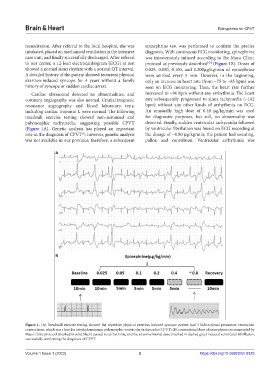
            resuscitation. After referral to the local hospital, she was   epinephrine test was performed to confirm the precise
            intubated, placed on mechanical ventilation in the intensive   diagnosis. With continuous ECG monitoring, epinephrine
            care unit, and finally successfully discharged. After referral   was intravenously infused according to the Mayo Clinic
            to our center, a 12-lead electrocardiogram (ECG) at rest   protocol as previously described [4,5]  (Figure 1B). Doses of
            showed a normal sinus rhythm with a normal QT interval.   0.025, 0.050, 0.100, and 0.200μg/kg/min of epinephrine
            A detailed history of the patient showed recurrent physical   were utilized every 5  min. However, in the beginning,
            exertion-induced syncope for 4  years without a family   only an increase in heart rate (from ~75 to ~85 bpm) was
            history of syncope or sudden cardiac arrest.       seen on ECG monitoring. Then, the heart rate further
              Cardiac  ultrasound  detected  no  abnormalities,  and   increased to ~96 bpm without any arrhythmia. The heart
            coronary angiography was also normal. Cranial magnetic   rate subsequently progressed to sinus tachycardia (~102
            resonance  angiography  and  blood  laboratory  tests,   bpm) without any other kinds of arrhythmia on ECG.
            including cardiac troponin I, were normal. The following   An unusually high dose of 0.40  μg/kg/min was used
            treadmill exercise testing showed non-sustained and   for diagnostic purposes,  but still, no abnormality was
            polymorphic tachycardia, suggesting possible CPVT   detected. Finally, sudden ventricular tachycardia followed
            (Figure  1A). Genetic analysis has played an important   by ventricular fibrillation was found on ECG recording at
            role in the diagnosis of CPVT ; however, genetic analysis   the dosage of ~0.80 μg/kg/min; the patient had sweating,
                                    [3]
            was not available in our province; therefore, a subsequent   pallor, and convulsion. Ventricular arrhythmia was

                         A


                         B


            Figure 1. (A) Treadmill exercise testing showed the repetitive physical exertion-induced syncope patient had 3 bidirectional premature ventricular
            contractions, which was a hint for catecholaminergic polymorphic ventricular tachycardia (CPVT).(B) conventional dose of epinephrine recommended by
            Mayo Clinic protocol (marked in solid black) caused no arrhythmia, and the unconventional dose (marked in dashed grey) induced ventricular fibrillation,
            successfully confirming the diagnosis of CPVT.


            Volume 1 Issue 1 (2023)                         2                         https://doi.org/10.36922/bh.0325

