


Page 89 - BH-2-2
P. 89
Brain & Heart                                                  Left PAPVC to left atrial appendage anastomosis


            that is, anastomosis connecting vertical vein to left atrial   course was confirmed. The junction of the vertical vein
            appendage, and highlight the procedural nuances for   to the innominate vein was then divided and transfixed
            patients with distinct age difference.             (Figure 2B). Left atrial appendage was opened longitudinally
                                                               on its dorsal surface after inducing cardioplegic cardiac
            2. Case presentation                               arrest. The open end of the vertical vein was fashioned to
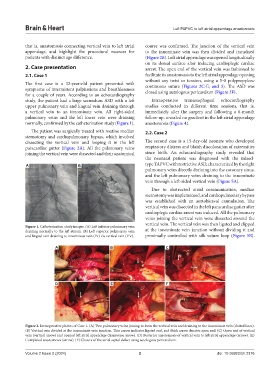
            2.1. Case 1                                        facilitate its anastomosis to the left atrial appendage opening
                                                               without any twist or tension, using a 5-0 polypropylene
            The first case is a 32-year-old patient presented with   continuous suture (Figures  2C-E,  and  3). The ASD was
            symptoms of intermittent palpitations and breathlessness   closed using autologous pericardium (Figure 2F).
            for a couple of years. According to an echocardiography
            study, the patient had a large secundum ASD with a left   Intraoperative  transesophageal  echocardiography
            upper pulmonary vein and lingual vein draining through   studies conducted in different time sessions, that is,
            a vertical vein to an innominate vein. All right-sided   immediately after the surgery and following a 6-month
            pulmonary veins and the left lower vein were draining   follow-up, revealed no gradient in the left atrial appendage
            normally, confirmed by the catheterization study (Figure 1).  anastomosis (Figure 4).
              The patient was surgically treated with routine median   2.2. Case 2
            sternotomy and cardiopulmonary bypass, which involved
            dissecting the vertical vein and looping it in the left   The second case is a 15-day-old neonate who developed
            paracardiac gutter (Figure  2A). All the pulmonary veins   respiratory distress and bluish discoloration of extremities
            joining the vertical vein were dissected and their anatomical   since  birth.  An echocardiography  study  revealed that
                                                               the neonatal patient was diagnosed with the mixed-
            A                     B                            type TAPVC with restrictive ASD, characterized by the right
                                                               pulmonary veins directly draining into the coronary sinus,
                                                               and the left pulmonary veins draining to the innominate
                                                               vein through a left-sided vertical vein (Figure 5A).

                                                                 Due  to  obstructed  atrial  communication,  median
                                                               sternotomy was implemented, and cardiopulmonary bypass
                                                               was established with an aortobicaval cannulation. The
                                                               vertical vein was dissected in the left paracardiac gutter after
                                                               cardioplegic cardiac arrest was induced. All the pulmonary
                                                               veins joining the vertical vein were dissected around the
                                                               vertical vein. The vertical vein was then ligated and clipped
            Figure 1. Catheterization study images. (A) Left inferior pulmonary vein
            draining normally to the left atrium. (B) Left superior pulmonary vein   at the innominate vein junction without dividing it and
            and lingual vein draining to innominate vein (IV) via vertical vein (VV).  proximally controlled with silk suture loop (Figure  5B).

                         A                      B                       C


                         D                      E                       F


            Figure 2. Intraoperative photos of Case 1. (A) Two pulmonary veins joining to form the vertical vein and draining to the innominate vein (dotted lines).
            (B) Vertical vein divided at the innominate vein junction. Thin arrow indicates ligated end, and thick arrow denotes open end. (C) Open end of vertical
            vein (vertical arrow) and opened left atrial appendage (transverse arrow). (D) Posterior anastomosis of vertical vein to left atrial appendage (arrow). (E)
            Completed anastomosis (arrow). (F) Closure of the atrial septal defect using autologous pericardium.

            Volume 2 Issue 2 (2024)                         2                                doi: 10.36922/bh.2376

