


Page 90 - BH-2-2
P. 90
Brain & Heart                                                  Left PAPVC to left atrial appendage anastomosis


            A                               B                  A


                                            C


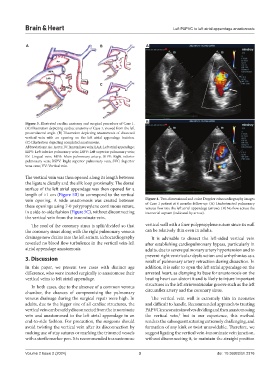
            Figure 3. Illustrated cardiac anatomy and surgical procedure of Case 1.   B
            (A) Illustration depicting cardiac anatomy of Case 1, viewed from the left
            posterolateral angle. (B) Illustration depicting anastomosis of dissected
            vertical vein with an opening on the left atrial appendage incision.
            (C) Illustration depicting completed anastomosis.
            Abbreviations: Ao: Aorta; IV: Innominate vein; LAA: Left atrial appendage;
            LIPV: Left inferior pulmonary vein; LSPV: Left superior pulmonary vein;
            LV: Lingual vein; MPA: Main pulmonary artery; RIPV:  Right inferior
            pulmonary vein; RSPV: Right superior pulmonary vein; SVC: Superior
            vena cava; VV: Vertical vein.

            The vertical vein was then opened along its length between
            the ligature distally and the silk loop proximally. The dorsal
            surface of the left atrial appendage was then opened for a
            length of >1 cm (Figure 5B) to correspond to the vertical
            vein opening. A  wide anastomosis was created between   Figure 4. Two-dimensional and color Doppler echocardiography images
            these openings using 7-0 polypropylene continuous suture,   of Case 1 patient at 6 months follow-up. (A) Unobstructed pulmonary
                                                               venous flow into the left atrial appendage (arrow). (B) No flow across the
            in a side-to-side fashion (Figure 5C), without disconnecting   interatrial septum (indicated by arrow).
            the vertical vein from the innominate vein.
              The roof of the coronary sinus is split/divided so that   vertical wall with a finer polypropylene suture since its wall
            the coronary sinus along with the right pulmonary venous   can be relatively thin even in adults.
            drainage now drains into the left atrium. Echocardiography   It is advisable to dissect the left-sided vertical vein
            revealed no blood flow turbulence in the vertical vein-left   after establishing cardiopulmonary bypass, particularly in
            atrial appendage anastomosis.                      adults, due to severe pulmonary artery hypertension and to
                                                               prevent right ventricular dysfunction and arrhythmias as a
            3. Discussion                                      result of pulmonary artery retraction during dissection. In
            In this paper, we present two cases with distinct age   addition, it is safer to open the left atrial appendage on the
            difference, who were treated surgically to anastomose their   arrested heart, as clamping its base for anastomosis on the
            vertical veins to left atrial appendage.           beating heart can distort it and is likely to injure important
              In both cases, due to the absence of a common venous   structures in the left atrioventricular groove such as the left
            chamber, the chances of compromising the pulmonary   circumflex artery and the coronary sinus.
            venous drainage during the surgical repair were high. In   The vertical vein wall is extremely thin in neonates
            adults, due to the bigger size of all cardiac structures, the   and difficult to handle. Recommended approach to treating
            vertical vein can be safely disconnected from the innominate   PAPVC in neonates involves dividing and then anastomosing
            vein and anastomosed to the left atrial appendage in an   the  vertical  vein,  but  in our  experience,  this method
                                                                             5
            end-to-side fashion. For precaution, the surgeons should   renders the subsequent suturing extremely challenging, and
            avoid twisting the vertical vein after its disconnection by   formation of any kink or twist unavoidable. Therefore, we
            making use of stay sutures or marking the trimmed vessels   suggest ligating the vertical vein-innominate vein junction,
            with a sterile marker pen. It is recommended to anastomose   without disconnecting it, to maintain the straight position


            Volume 2 Issue 2 (2024)                         3                                doi: 10.36922/bh.2376

