


Page 11 - DP-1-1
P. 11
Design+                                                                         Designing future schools


              The  trend  for  differentiated  learning  environments   Table 1. Summary of design concepts and considerations
            within a school continues in different ways today. Unlike
            the rapid rise and fall of open-plan spaces in the middle   Design concept  Design considerations
            of  the  20   century,  it  may  be  that  the  current  trend  for   Context, culture,  •  Features that afford sensory, movement, and
                   th
            flexible and multi-formed environments is based less on   and place  introspective experiences to create immersive
                                                                             environments
            revolutionary zeal and more on the dual drivers of the          •  Expressive response to the local landscape,
            preparation for participation in the future economy and          including palette
            responding to possibilities of new technology. 15               •  Acknowledgment of First Nations stories and
                                                                             connections to context
            3. Education concepts and design                                • Access to outdoor natural spaces if possible
            considerations                                     Community    •  A coherent and integrated range of diverse
                                                               ecosystem     teaching and learning spaces that allows student
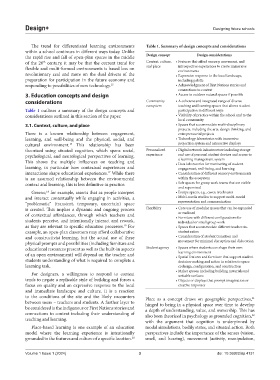
            Table  1 outlines a summary of the design concepts and           participation in different ways
            considerations outlined in this section of the paper.           •  Visibility of practice within the school and to the
                                                                             local community
            3.1. Context, culture, and place                                •  Spaces that accommodate multi-disciplinary
                                                                             projects, including the arts, design thinking, and
            There is a known relationship between engagement,                entrepreneurial projects
            learning, and well-being and the physical, social, and          •  Technology laboratories with immersive
            cultural environment.  This relationship has been                projection system and interactive displays
                               16
            theorized using situated cognition, which spans social,   Personalized   •  Digital network infrastructure including storage
            psychological, and neurological perspectives of learning.   experience  and use of personal student devices and access to
                                                                             a learning management system
            This  shows  the  multiple  influences  on  teaching  and       •  Data laboratories for monitoring of student
            learning, in particular how contextual experiences and           engagement, well-being, and learning
            interactions shape educational experiences.  While there        •  Consideration of different sensory environments
                                               17
            is  an assumed relationship between  the  environmental          within the ecosystem
            context and learning, this is less definitive in practice.      •  Safe spaces for group work teams that are visible
                                                                             and supervised
              Greeno,  for example, asserts that as people interpret        • Escape spaces, e.g., caves, treehouses
                     18
            and interact contextually while engaging in activities, a       •  Multi-media studios to support multi-modal
            “problematic” (transient, temporary, uncertain) space            representation and communication
            is created. This implies a dynamic and ongoing process   Flexibility  •  Core use of modular spaces that can be expanded
                                                                             or enclosed
            of  contextual  affordances,  through  which  teachers  and     •  Furniture with different configurations for
            students perceive, and intentionally interact and rework,        individual or small group work
            as they are relevant to specific education processes.  For      •  Spaces that accommodate different teacher-to-
                                                      19
            example, an open-plan classroom may afford collaborative         student ratios
            and constructivist learning, but the actual use of these        •  Consideration of student transition and
            physical prompts and possibilities (including furniture and      movement for minimal disruption and dislocation
            educational resources present as well as the built-in aspects   Student agency  •  Spaces where students can shape their own
                                                                             learning environment
            of an open environment) will depend on the teacher and          •  Spatial features and furniture that support student
            students understanding of what is required to complete a         decision-making and action in relation to space
            learning task.                                                   codesign, configuration, and construction
                                                                            •  Maker spaces, including building materials and
              For designers, a willingness to respond to context             writable surfaces
            tends to negate a replicable style of building and forces a     •  Objects or displays that prompt imagination or
            focus on quality and an expressive response to the local         creative responses
            and immediate landscape and culture. It is a reaction
            to the conditions of the site and the likely encounters   Place as a concept draws on geographic perspectives,
                                                                                                            21
            between users – teachers and students. A further layer to   hinged to being in a physical space over time to develop
            be considered is the indigenous or First Nations stories and   a depth of understanding, value, and ownership. This has
            connections to context  including  their  understanding  of   also been theorized in psychology as grounded cognition,
                                                                                                            22
            teaching and learning.                             with the argument that cognition is underpinned by
              Place-based learning is one example of an education   modal simulations, bodily states, and situated action. Both
            model where the learning experience is intentionally   perspectives include the importance of the senses (vision,
            grounded in the features and culture of a specific location.    smell, and hearing), movement (activity, manipulation,
                                                         20

            Volume 1 Issue 1 (2024)                         3                                doi: 10.36922/dp.4131

