


Page 11 - DP-2-1
P. 11
Design+                                                          The transformation of the automotive industry


            findings concerning the technological drivers of change.   abstracts to optimize the number of relevant results. The
            The primary aim of this publication is to summarize the   keywords were used in English, based on insights from
            existing literature. A neutral, representative perspective was   the VHB-Jourqual Ranking search. A total of 18 relevant
            consistently adopted for the literature search and analysis to   sources were identified, and after checking for duplicates,
            provide an objective overview of the literature. The scope of   11 essential sources were selected to answer the research
            the review is characterized as selective, meaning that after   question. To ensure transparency in the literature selection
            an exhaustive search, the focus was narrowed to the most   process, a PRISMA flow diagram (Figure  2) is provided
            essential content. In addition, a conceptual framework was   below. It illustrates the different phases of identification,
            chosen for this work. The paper is intended for the general   screening, eligibility, and inclusion, offering a structured
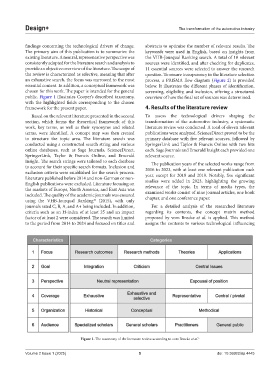
            public. Figure 1 illustrates Cooper’s described taxonomy,   overview of how the final set of sources was determined.
            with the highlighted fields corresponding to the chosen
            framework for the present paper.                   4. Results of the literature review
              Based on the relevant literature presented in the second   To assess the technological drivers shaping the
            section, which forms the theoretical framework of this   transformation of the automotive industry, a systematic
            work, key terms, as well as their synonyms and related   literature review was conducted. A total of eleven relevant
            terms, were identified. A concept map was then created   publications were analyzed. ScienceDirect proved to be the
            to structure the topic area. The literature search was   primary database with five relevant sources, followed by
            conducted using a constructed search string and various   SpringerLink and Taylor & Francis Online with two hits
            online  databases,  such as  Sage  Journals, ScienceDirect,   each. Sage Journals and Emerald Insight each provided one
            SpringerLink, Taylor & Francis Online, and Emerald   relevant source.
            Insight. The search strings were tailored to each database   The publication years of the selected works range from
            to account for their specific search formats. Inclusion and   2016 to 2023, with at least one relevant publication each
            exclusion criteria were established for the search process.   year, except for 2018 and 2019. Notably, five significant
            Literature published before 2014 and non-German or non-  studies were added in 2023, highlighting the growing
            English publications were excluded. Literature focusing on   relevance of the topic. In terms of media types, the
            the markets of Europe, North America, and East Asia was   examined works consist of nine journal articles, one book
            included. The quality of the academic journals was ensured   chapter, and one conference paper.
            using the VHB-Jourqual Ranking   (2015), with only
                                         36
            journals rated C, B, A, and A+ being included. In addition,   For a detailed analysis of the researched literature
            criteria such as an H-index of at least 25 and an impact   regarding its contents, the concept matrix method
            factor of at least 2 were considered. The search was limited   proposed by  vom  Brocke  et al.  is  applied.  This  method
            to the period from 2014 to 2024 and focused on titles and   assigns the contents to various technological influencing


                                   Figure 1. The taxonomy of the literature review according to vom Brocke et al. 5


            Volume 2 Issue 1 (2025)                         5                                doi: 10.36922/dp.4445

